
Tags
I think I had the best job I ever had in high school.
My single mother worked at a real estate company helmed by a strong and independent woman. Her name was Sue Miller. Sue was the force behind Frank Wylie Realty, and had become president of the small company. My mother and Sue became good friends, and as youngsters, we were often in the office while my mom worked the phones or made appointments or researched home values. Back then, of course, there were only printed MLS books each week, hardbound phone books, and typewriters. You had to work in an office, there was no such thing as the internet. So, while we were there, we had to make ourselves scarce and stay out of trouble.
I made my way to Sue’s office, most of the time. She had a brown leather chair, button-tufted upholstery, armrests, and a high executive back. Her desk faced the door, and there were bookshelves behind it with a credenza to the left. I would sit there, imagine myself as an executive, and occupy myself by sketching planes, cars, and guns. Sue was a person who had a zeal for life, and in her zeal she made things happen. One day she bought a plot of useless land on the side of Chapman Highway, with no space for any buildings. The land rose quickly from the small parking lot, being essentially a hillside, and was covered with trees. To Sue, it was perfect. Perfect for a water slide! The only slide in the area was miles away, and you took Chapman Highway to get to it. Sue built a water slide with a concrete U-shaped river down the hill, complete with bath houses and refreshment stand, and for a few years managed to enjoy a break-even existence. We splashed down the hill on rubber mats often, as we had special membership privileges and no ticket cost.
Sue was single, but cared about my sister and me. We didn’t understand why we were special to her, but were grateful. The summer before high school, Sue knew I needed to earn money. She drove up to our home one day, opened her trunk, and presented me with a lawnmower. She included everything I needed. And, with all her rental and commercial property, she had plenty of lawns to mow. I had to mow a couple of rental house yards that were overgrown, with grass at least two feet high. I had to mow an entire apartment complex yard with a 22-inch mower. I think that took me three days. In her own way, she kept track of the yards I mowed, and every week I kept at it. That summer, I was traveling to Austria on a summer exchange program, and spending money was needed. Instead of paying me for each yard, when I did it, Sue banked the money on my behalf. The week before I flew to Austria, she came to our house and gave me $250. I had never seen so much money. It made the trip special, having that money to buy souvenirs and food. Wandering around Austria, I watched the trip leader take snapshots with a special camera that interested me. It was small and so perfectly engineered. Right there in Salzburg I was able to buy a Minolta Hi-matic F 35mm camera similar to his Rollei Trip 35 with half of my lawnmowing money, so I could take pictures while on the five-week trip. That camera I used all through high school, and I still have it today. I keep in in a safe place, as it is a souvenir of value.

Sue knew I wanted to participate at Webb School on the track team, and took me to Athletic House on Gay Street in downtown Knoxville for special running shoes. They were white leather, with three green stripes. Webb School colors. Adidas. She even took me out to the school track about 25 miles away for me to try the shoes out. I think now that Sue was a woman who had a gift for parenting, but was not able to participate as most women did, never getting married, but staying home, and caring for us kids. Sue’s life was different, and exceptional in its genuine sharing of emotion and passion.
She had a Honda Trail 90, that she mounted to her Winnebago RV. I learned to ride a motorycle on that Honda. I’m not sure my Mom approved, but it was not much bigger than my bicycle.

Sue couldn’t drive a car. Sue needed a car. As long as I knew her, she drove a car that everyone wanted, and no one could afford. A 1972 Cadillac Eldorado convertible. Gold, with parchment leather upholstery and a white top. It looked similar to this one.

It had a 500 cubic inch V8 engine, and front wheel drive. It was amazing. To Sue, it was transportation. She never spoke of the car, never bragged about the car, but she drove everywhere in it.
Sue found a house at 3828 Maloney Road way out off Alcoa Highway, with a pool, overlooking the river.
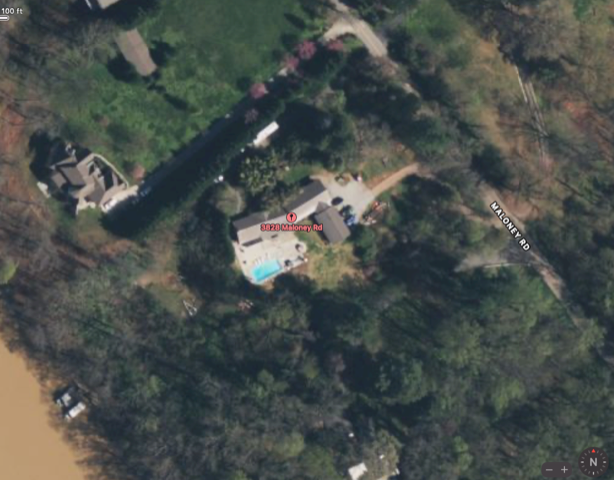
There, she had a pool table, a big TV with what at the time was unheard of…a Sony Betamax videotape player. Sue allowed our Sunday School class to have a swimming party at her place. At Christmas, we were never sure what to expect. One year she gave me a Winchester .22 rifle, and another year she gave me a stereo system. There was no end to Sue’s thoughtful generosity.
And, one day, before the school year ended, she rolled up in that big Eldorado, and drove me to a service station. It was the Cloverleaf Servicenter. A Union 76 station. The gentleman who filled the tank knew Sue, and they talked for a while. I was introduced to Buster, the owner. We spoke for a few minutes, and then Sue and I drove away. On the way home, she said “You’ll start work there on Monday.”
I was thrilled. Working at a service station? The young man who for years had drawn racing cars. The young man who had attempted to disassemble a junkyard Ford V8 engine that my mom gave me to learn on when I was ten years old. Now, I would be working for real, on cars and trucks. And making money!
So many memories of that first job flood my mind. Pumping gas, washing windshields, checking oil, and inflating tires was my main job. It was a full service station, and we did not permit self service. Buster was a great boss, and the co-owner Kenneth Cunningham was a superb mentor. People in the neighborhood drove up regularly, and I learned many by name. Some wanted a small amount of fuel, while others were “fill’er up!” Most of the time, they said “put it on my account” and I would write down the amount on a small pad with carbon paper between leaves of paper, then put them in the cash register. Most people paid with cash. A few people used a credit card, and we had to “run” the card through the impression machine with the loud rackity-rack sound of the sliding bar. I stayed busy on the front. I got to where I could dispense a dollar amount of fuel just by listening to the pump meter click. People would worry that I wasn’t watching, but I could nail getting some dollar amount just counting the clicks of the ten cent wheel.
Our pumps looked like this, and the price per gallon setting didn’t have a dollar quantity!

There were a few memorable characters that came often. One was a University of Tennessee professor named Bill. He had the beard, the moustache, the wire-frame glasses, and the attitude. He bought the first Mazda rotary engine RX-7 we had ever seen, and I managed to spill a bit of gas from the nozzle onto the paint. I quickly grabbed my red rag from my back pocket, and proceeded to smear oil from the dirty rag onto the paint as I attempted to wipe the gas away. He said “go be nice to someone else.”
Another frequent customer was “Maypop.” He was a nice older man, slow moving, and often wore a summer straw hat like a golfer might wear. He slowed to a stop, asked for gas, and then talked for a long while with Buster. He always moved with that body motion that suggested he might fall over if he didn’t get his weight centered over each leg, kind of a side to side rocking step. I asked Buster why we called him “Maypop.” Buster said that for many years he would drive in on tires that were well worn out, that “may pop” at any moment. He never wanted to buy tires, so Buster gave him that nickname to remind him of his potential misfortune. I think I did actually change his tires one day, though.
Another car that one couldn’t miss would slowly creep through the lot to the pumps. It was so low to the ground, essentially riding on the frame, because its owner kept putting newspapers in the car. Kelly was a sickly man, pale and white, with long greasy grey hair, pronounced prescription glasses and a pot belly. He was supposedly a Knoxville newspaper delivery man, and had a route nearby. Having been a delivery boy some years ago, I recognized the bundles of newspapers in Kelly’s car. What I didn’t understand is why Kelly kept adding bundles and bundles and bundles to the interior. The entire back seat was filled to the roof with newspapers. The front passenger seat was nearly filled. The trunk was full. Kelly had only a small space in which to drive. He was a regular customer, but couldn’t afford much gas. His car would slowly meander away, down the dead-end street, and I would shake my head in disbelief. His car would never go over about 10 mph, as heavy as it was.
Many days we had a car drive in, get a little gas, and ask for directions to Interstate 81. It was so frequent, that we had a speech prepared with the exact mileages to the interchange. For whatever reason, back then, people without GPS and maps just navigated by feel, and since downtown Knoxville had “Malfunction Junction” of I-40 and I-75, people found themselves on I-75 N trying to get to I-81 N. We would turn them around, and thank them for stopping by.
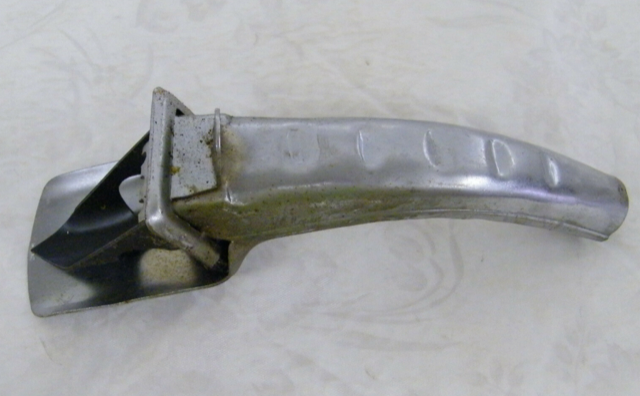
Besides working on the front, I did get to work on cars. Oil changes were commonly required, in those years, and we had a lot of basic maintenance business. Back then, we had three or four oil filters that covered essentially every cary. Fram. PH8 for Ford. PH43A for Chrysler. PH30 for GM. Our parts supplier kept the stock room rack full every week. I learned to put the car on the rack, “dog it” with the lifting bars, lift it up, drain the oil, replace the filter, and grease the suspension fittings and U-joints. I also checked the rear axle fluid level. Back on the ground, I put in the typical five quarts of oil. Depending on the customer’s budget, we would use Union 76 oil having gold “Super” or red “Premium” or blue “heavy duty” colors. Some customers wanted Kendall oil, thought to be even higher quality, which came in a black can. Of course, these were waxed paper containers, with metal disks at top and bottom, and we had to use the oil spout that pierced the top of the can to get the oil into the engine.

I also learned how to change tires. Here, I would bring the car in, get it up on the lift, remove all four wheels from the car, dismount the old tires, mount the new tires, balance the tires, and reinstall them on the car. My personal record was 45 minutes to do four tires. Back then, the tires were called “bias ply” tires, and were often sized by width and wheel diameter. F78-14 was a tire for a typical sedan, and muscle cars had tires like a G70-14.


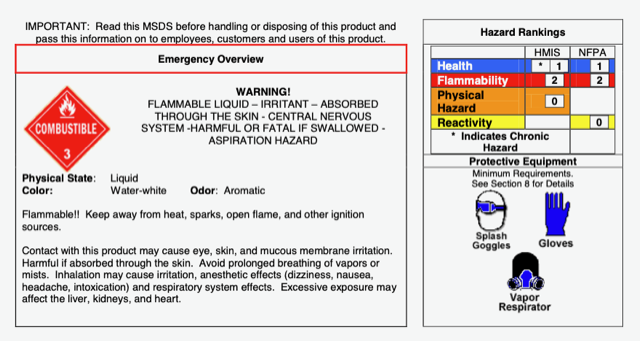
Summers at Cloverleaf were hard work, and it was hot. Buster had me there from 10 am to 7 pm, every day. On Saturday, we had to clean the station. Everything. We used a solvent called Varsol to mop the concrete shop floors. I sometimes dampened a red rag with Varsol, as it was useful in cleaning tools. But, one day early in my career I kept that Varsol rag in my back pocket all day. The next day I had a chemical burn on my left cheek. It was not a good day.

Today if we look up the safety info, we can see why that skin burned!
I wiped down all the sockets and wrenches to get rid of the oil film. I stocked the oil and filters and wipers and tires and belts. I hosed out the restrooms, which were paneled in what looked like Tennessee marble stone tiles from floor to six feet up. And, I hosed down the entire asphalt parking lot, moving every single pebble, rock, gum wrapper, leaf, or trash into the storm sewer at the north end of the lot. I was out in the sun for hours.
At lunch, I would retreat into the fourth shop bay where no one could see me. There, I would eat my lunch, that my mom packed. I don’t know how I ate all the food she packed, but I did. Usually each day I ate four sandwiches and a thermos container of bean soup. I couldn’t eat four sandwiches today if I spaced them out over breakfast lunch and dinner. But, I was worn out and growing and needed calories. I’m glad she made them for me. I’d supplement my lunch with a couple cans of Coke from the machine out in the shed, and maybe a pack of peanut butter crackers too. I worked.
Back in the shop, Jack worked too. He was not a person that Buster wanted in front of customers. He was a shorter man, somewhat broad of chest and hip, and his skin was stained a permanent brown from oil and grease. He didn’t talk, as much as he grunted. His teeth were rotting away, and his unkempt hair was filled with grease as he often ran his dirty hands through the long hair to keep it out of his eyes. His uniform shirts were blue, stained with oil. But, for those really challenging repairs, Jack was the man. He replaced the lifters in my 1966 Mustang 289 V8 engine one week, doing a complete valve job as well, and the car ran like a rocket afterwards. Jack was nice, but a person you just didn’t see that often.
In the front three bays, Carl worked with me. Carl was a very slim man, with short-cropped hair having grey and black colors. His face was sagging, wrinkled a bit, and his teeth were stained with the nicotine from the cigarette dangling from his mouth. His uniform was spotless, and he kept it so by thinking carefully about where to place his body around the work. Often he would drape a red shop rag on the floor before kneeling on that spot, to keep his pants clean. Carl balanced pumping gas and general maintenance tasks.
Kenneth usually worked in the middle bay. He was the brains of the operation and a co-owner. Any tune up most often required Kenneth’s expertise. He could operate the “Sun machine” and figure out just what to replace from the curious signals shown on the screen. Each cylinder gave a flickering blue line, and he could tell if the car needed points, condenser, plugs, wires, or everything.

He knew everything there was to know about carburetors, and I watched him rebuild them without looking at the parts, just working from feel. Every once in a while a car came in that couldn’t charge its own battery, and Kenneth would take the alternator and regulator down to Knoxville Generator where he rebuilt those. He was gregarious, loved to speak to anyone with a story or two to share, and made the entire operation pleasant. His catch phrase was “I’ll tell you what…” which he always followed with some humorous wisdom. He chewed a little tobacco, drank Cokes and ate peanut butter crackers incessantly, and made sure I was busy. There is an episode of Andy Griffith featuring Gomer Pyle as the talkative grease monkey, and cars gathering all around the shop for repair work. Our back lot was filled with broken cars because people liked talking to Kenneth, and trusted him to do the right thing. He was our Gomer Pyle. His wife Kathy worked in the station office, doing the books. His son joined us also, as he grew up.
Buster was the owner, the driving force, and the decision maker. He was about six feet tall, a bit overweight, balding with white short hair, and I never saw him without a plug of Red Man tobacco in his cheek and a fresh bag in his hip pocket. He wiped his sweat off his head often with a dirty shop towel, and kept the shop clean and neat. He drove the red Ford wrecker, picking up all sorts of vehicles needing our repairs. He was a WW2 veteran, and told me that he drove the landing craft to the beach and back in the Pacific theater. One battle he made it back and forth five times. He also relished in the Navy tradition of crossing the equator or date line, and hazing the sailors who had never crossed with truly gross and disturbing materials. Buster was the boss to fear, but he was really a soft soul. He had a buxom blonde girlfriend, without whom he would have been lost.
For about three summers and on Saturdays throughout the school year, I was at Cloverleaf. Every day was routine and different, all at the same time. I learned a lot about cars. I learned how to work. But mostly, I learned about people. The coworkers and clients each brought such different life stories to me, I couldn’t help but be fascinated. I realized that I would enjoy working in the car industry, but probably not at a service station. But, I still have one shirt from those days, hanging in my attic, reminding me of what hard work really is. You can see where I tore the long sleeves away during the hot summer.

My memories of a classic full service gas station are obliterated as I look at the place today. It’s the same building, in the same place, but it has been destroyed by the ever-changing world we live in. The bathroom doors on the side wall are still there…the office windows and front door, and the four bays remain. But, my station is gone.
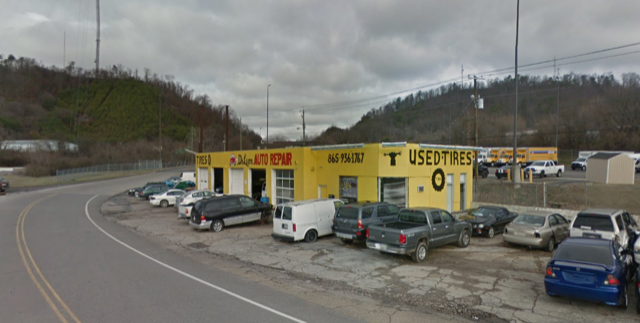

I’ll never forget the day Sue took me here for the interview with Buster, and how her relationships with people were so valuable. Thankfully lessons from my years at Cloverleaf remain in my heart and head. I think I’d still like to work there today…if only it were as it was then.
 Seeking To Understand