
Fitness From Fear

I’m a member of an incredible fitness program, called X-Team Fitness.

x-team logo doodle

Our program is based on five principles that make it special. Testing, nutrition, accountability, community, and variety make X-Team different, and it is a vital part of my daily life.  We meet early in the morning or late in the afternoon, and in a variety of locations around Richmond, Virginia, including the X-Box at 2928 West Leigh Street.

I joined X-Team in October 2017, completed the introductory six-week fitness challenge, and then continued exercising until about the end of January 2018. My thinking was that I could maintain fitness on my own, with the discipline of the previous months ensuring I would exercise regularly. In fact, I did exercise regularly, throughout the winter and spring, by myself.  My workouts were simpler, shorter, and based on road running. Somehow I maintained a basic fitness level, and lost a little weight.

But, in May of 2018, while at my daughter’s college graduation, I unexpectedly recognized that my leaving a number of activities over the years, including X-Team, was based on a fear.  I was afraid of failing. My fear was based on a belief that my performance was not sufficient, not good enough, not worthy, and did not meet a standard. I think most people would call this “performance anxiety.”

Over the next few weeks, I focused my attention on the causes of my performance anxiety.  Introspection led me to three main elements of my fear. These are

  • Unreasonable expectations
  • Lack of courage
  • Need for affirmation

Each of these three can be compared to the fire triangle of fuel, air, and heat. When all three are present, a fire burns within, and that fire, like most fires, creates fear.

X-Team is an incredible workout, and challenges even the most physically-fit individual. Working out in a group, under the direction of a very capable leader, it is very easy to find yourself thinking “I can’t do this.  I’m really out of shape. These exercises are hard to do. I can’t even do some of these.” Each hour of the workout, you can, very easily, fuel the fire of performance anxiety.  At the end of a workout, you can feel consumed by that fire.

For me, it began with unreasonable expectations.  After only a few weeks with the team, I thought I could run with the long-time members.  I thought I should be able to run with the long-time members.   Instead, running in the back, I fell into a trap where I compared my performance to my own unreasonable expectations.

Along with my unreasonable expectations, I found that some exercises were truly challenging to me.  Concerns about injury, pain, and safety for a risk-averse engineer like me are easy to say out loud.  But, deep down, what kept me from progressing was my own lack of courage. Can I dead lift 150? Can I leap this creek without spraining an ankle?  Can I run faster even though my heart is beating about as fast as it can? Without courage, I found myself in the back of the pack, making excuses, and rationalizing why I couldn’t do some activities.

High expectations and low courage were amplified by a belief that I needed affirmation for what I was doing.  Most of my life, I’ve sought out affirmation. I think we all do. But, at some point, we do need to recognize that our affirmation, our sense of worth, must come from within.  Many learn this at an early age. For me, it’s taken too long.

On that special day, my younger daughter’s graduation, for whatever reason, it clicked.  I saw the issue more truthfully. In time, I understood it. I could make sense of it. And, I wanted to never experience that anxiety again.

So, I began to train harder, by myself.  I let the X-Team know I would be back on August 1, 2018.  I rejoined, with a sense of purpose, but more importantly, with an awareness that I had changed.

Since then, my time with X-Team has been transforming.  If we look at what has happened, we can see that each factor that creates performance anxiety has been attacked.  You could say that these three factors have been vanquished.

First, I’ve challenged my expectations.  Can I run like some on the Team? Can I lift as much weight?  Nope. So, what are my expectations? No longer are they to be like others. My expectations are now different. I expect to give each workout everything I have.  I expect to be tired. I expect to be challenged. I expect to be worn out. And, I expect to be back the next day, ready for more.

Secondly, I’ve become more courageous.  Some of the exercises can challenge your self-confidence.  Can you imagine carrying someone weighing 200 pounds on your back up a steep hill in near darkness?  I’ve done it. More than once. I’ve climbed up a concrete railroad trestle foundation about twelve feet tall. I’ve run further than I’ve ever run–15K in the dead of winter.  I’ve cycled 63 miles in a day, keeping up with a very fit team member. Each of these events was based on a newfound courage. I can do this.  I will do this.

Finally, I’ve eliminated the need for external affirmation.  No longer do I need that feedback to keep me going. I know I’m doing the right things for me.  I know I’m getting better every day. I know after every workout, when I climb into the car and head home, I’m better than I was the day before.  I can see it. I can feel it. And, with X-Team Fitness measures, I can be certain of it.

Conquering performance anxiety is an incredible feeling.  It gives me a sense of joy. True joy. Not happiness. Joy.  Feeling that joy, I can set goals. Goals that drive me forward.  This year, I have three. Run the Monument Avenue 10K in fewer minutes than my age.  Ride a century (100 miles). Bench press 1.5X my body weight.

Together, with friends in the X-Team, I know I’ll make it.  Training with these friends means the world to me. Being on a journey, together, I’m confident I can achieve my goals.

An Evening Downtown…

I went to an art show yesterday, at the behest of SWMBO (She Who Must Be Obeyed).  For the record, I would never willingly go to an art show, because, well, you  know, artists are, well, different.   It was a pleasant enough experience, once we navigated to a decrepit old warehouse in a forbidden part of town where the prudent gentlemen carry large-caliber firearms just in case.  There, we mingled with the casually-dressed cognoscenti in a space where dozens of visual artworks were displayed.  Wine, cheese, crackers, and crab dip were available for donations to the cause.  Sadly, due to a line of storms that passed through Richmond as the show began, all but emergency lighting was out.  We mingled amongst the patrons with the fading light of day piercing the dirty skylights of the warehouse, bathing the colorful art in a grey hue of blandness.

As the awards for the show were announced, we found our artist friend at his displayed photograph taken in Cuba.  He was dressed in a pair of Birkenstock sandals, over black socks splashed with stripes of color, black pants, black shirt, a grey blouse jacket, and a multicolor scarf knotted around his neck.  His shining silver hair and beard were eclipsed by the smile on his face, as he explained the art behind his work to the passerby.  He had been to Cuba with a group, and his photograph differed markedly from others displayed on a nearby wall.  His image included a building and sidewalk, nothing noteworthy by itself, enhanced with a dreamy ocean background that covered the entire frame.  It was a double image, taken in camera, while there in Cuba, somehow.  Most people would do such work in an image editing software, but he had seen the picture in his mind and captured it real time.  Art.

As the evening light faded, we wandered around the space, looking at all the images there.  Some were very realistic, while others were a challenge to understand.  There was three-dimensional art, as sculpture, diorama, or…I don’t know what…a wall hanging collection with a fan propellor, a wire mesh basket filled with smooth river stones, a piece of driftwood, all mounted on a wooden carved S shape.  There were many paintings with wax as an element, adding some texture to the swaths of color.  There were several paintings of faces, some absolute, some abstract, and some anguished. One piece was of a face, made of colored glass beads, each about the size of a caraway seed.  Seeing the blazing light of my phone which illuminated the colorful beads, the artist excitedly came over to share her joy at being displayed at such a show.  Her smile was brighter than a kid’s on Christmas morning.

Each artist had made a statement for their work, stuck to the wall on a little white foam block.  The words attempted to convey the artist’s intent, feeling, purpose, or meaning.

Screenshot 2019-03-23 at 07.24.22 Looking at the art, then reading the statement, then looking back at the art, one could wonder if they all said the same thing.  To me, each statement and artwork spoke of one force, that of creation, bubbling up and exploding in a frenzy of activity finally captured in the objet d’art.  Each piece seemed to carry with it a passion for expression of emotion, of joy in the ability to create.  Each offered to the viewers a window on a soul that wanders the earth marveling at or mourning what the artist observes.  And each piece showed that this life of wonderment and expression would never stop.

I want to be an artist.

When The Wind Blows

Recently Hurricane Florence came ashore in North Carolina.  In the days leading up to its landfall, my town of Richmond, Virginia was buzzing with activity as people prepared for the possibility of power outages, trees falling, and general chaos.  Like many, I watched the tracking of the storm, but with more concern than usual since my daughters live on the east coast.  The daughter I love the most lives in Charleston, SC, while my favorite daughter lives in Newport News, VA.  Or maybe it is the other way around.  Needless to say, a father always worries about his children, and this storm had me doubly worried.

The hurricane track ultimately focused on North Carolina, about 150 miles from Charleston and 210 miles from Newport News.  I silently breathed a prayer of thanks to God, that my kids were likely as safe as could be from this storm, with its track right between them.  My daughters’ extensive preparations were well thought out, and likely would have been effective, but we were relieved nonetheless.

I have thought about praying to God a lot these days.  At my church, Hope Church, we just finished a sermon series on prayer.  The crowds that attended attest to our natural curiosity about prayer.  The last sermon was one that highlighted questions we all have about prayer.

Hurricanes cause many to pray, before, during, and after the storm.  When we face challenging circumstances, we can and should pray to God, keeping in mind seven principles.

The first principle is found in Matthew, chapter 8.

24 Suddenly a furious storm came up on the lake, so that the waves swept over the boat. But Jesus was sleeping. 25 The disciples went and woke him, saying, “Lord, save us! We’re going to drown!”

26 He replied, “You of little faith, why are you so afraid?” Then he got up and rebuked the winds and the waves, and it was completely calm.

27 The men were amazed and asked, “What kind of man is this? Even the winds and the waves obey him!”

Here, we see that God controls the world, and everything in it.

The second principle is shown in 1 Kings, chapter 17, where Elijah remains with a widow and her son during a drought.  We read in verses 14 through 16.

14 For this is what the Lord, the God of Israel, says: ‘The jar of flour will not be used up and the jug of oil will not run dry until the day the Lord sends rain on the land.’”

15 She went away and did as Elijah had told her. So there was food every day for Elijah and for the woman and her family. 16 For the jar of flour was not used up and the jug of oil did not run dry, in keeping with the word of the Lord spoken by Elijah.

Here, we see that God provides for us.

The third principle can be viewed in Proverbs, chapter 2.

For the Lord gives wisdom;
    from his mouth come knowledge and understanding.
He holds success in store for the upright,
    he is a shield to those whose walk is blameless,
for he guards the course of the just
    and protects the way of his faithful ones.

Here we see that God protects us.

The fourth principle is seen in Paul’s second letter to the Corinthian church, chapter 1.

We do not want you to be uninformed, brothers and sisters, about the troubles we experienced in the province of Asia. We were under great pressure, far beyond our ability to endure, so that we despaired of life itself. Indeed, we felt we had received the sentence of death. But this happened that we might not rely on ourselves but on God, who raises the dead. 10 He has delivered us from such a deadly peril, and he will deliver us again. On him we have set our hope that he will continue to deliver us, 11 as you help us by your prayers. Then many will give thanks on our behalf for the gracious favor granted us in answer to the prayers of many.

Here, we see that God delivers us from harm.

The fifth principle is recounted in Luke 5, verses 12 and 13.

12 While Jesus was in one of the towns, a man came along who was covered with leprosy. When he saw Jesus, he fell with his face to the ground and begged him, “Lord, if you are willing, you can make me clean.”

13 Jesus reached out his hand and touched the man. “I am willing,” he said. “Be clean!” And immediately the leprosy left him.

Here, we see that God heals us, most notably from illness.

The sixth principle is shared in Psalm 145, verse 14 through 16.

14 The Lord sustains all who fall
And raises up all who are bowed down.
15 The eyes of all look to You,
And You give them their food in due time.
16 You open Your hand
And satisfy the desire of every living thing.

Here, we see that God sustains us.

The seventh principle is noted in many passages, with one oft-repeated from Psalm 23, the first three verses.

1The Lord is my shepherd, I shall not want;
    he makes me lie down in green pastures.
He leads me beside still waters;
    he restores my soul.
He leads me in paths of righteousness
    for his name’s sake.

Here, we find that God restores us, His ultimate aim and purpose.

God’s Word reveals His love for us, no matter our circumstances, and offers us these principles and many others that attest to God’s care for us.  As we face life’s uncertainty, may we always turn to the Lord and share our fears, our hopes, and our needs.  In prayer, God will always bring us closer to Him, as He wraps his arms around us in love.  Let us cry “Abba” (Daddy) to God, in our hurricanes.

Judge not, lest ye be judged

You know how sometimes you wake up just enough in the middle of the night. Something makes a noise, or maybe you have to get up. This morning, sometime, in the darkness, a thought came to me, as I was not fully awake, but not asleep…

When love ends, judgment begins.

I hope that I can remember this, and when I sense myself judging someone else, that I try my best to stop and love them.

The Bible gives us these commands:

Love your neighbor as yourself. (Matthew 22:39)

Do not be judged, or you too will be judged. (Matthew 7:1)

And, as we wonder how to love others, the Bible teaches us:

Whoever does not love does not know God, because God is love. (1 John 4:8)

May I know God more today, that I may love others like He loves us.

Getting Things Done

Some nights you fall asleep so deeply, that the next day you don’t want to get out of bed.  Some nights you can’t sleep, and you can’t wait to get out of bed.  Some nights you sleep, but you might as well be awake as you are dreaming of work.  We’ve all been there.  It’s those times in our lives when we face a daunting challenge.  We never know from where that challenge will come.  Often it is a project at work.  Sometimes it is even the job itself.  What do we do?  How?  Where can we find guidance for our work life?  Of course, there are many books on work to read, so many we don’t know where to start. In the modern world, we listen to podcasts and watch TED Talks for insight.  What we may not realize is that God’s Word shares a great example of getting things done.  Our example is in the book of Nehemiah.

Nehemiah was of the nation of Israel, and had been exiled to another nearby country in the continuing battles for regional supremacy of that time.  Even as a Jew, he had risen to a fairly high position, serving as an assistant to the king himself.  You might say he had it made.  But, Nehemiah realized one day that his city was in need.  Men from his home had come to visit, and shared a terrible story.  Walls torn down, gates shattered and tossed aside, and damage from the fires of a conquering army had made his city desolate.  It really wasn’t much of a city any more.

Hearing this report, Nehemiah was, in a word, broken-hearted.  We can imagine how we might feel, learning that our childhood home was burned and destroyed.  The emotional impact was so strong that Nehemiah could think of nothing else for days.  Nehemiah realized that he had a new job.  He had to rebuild the city.

When you read God’s Word, it is easy to let your eyes follow the words along, to read quickly, and to see that Nehemiah had a new job.  Sure.  Rebuild the city.  Wait!  Are you kidding me?  Rebuild a city?  If you’re like me, you can’t even rebuild the broken down decorative fence that surrounds the air conditioning unit at your home.   If you’re like me, you have several projects in the garage that are almost done.  Or almost started.  Or maybe you just need to go and find that special tool for the job, and then you can get started.  Rebuild a city?

How could Nehemiah even start?  Let’s look at the first two chapters and see how God’s Word gives principles about getting things done…

Verse Observation Application
1:2b Nehemiah asks about his people Do we have interests of others in mind?
1:4a Nehemiah has true empathy Do we emotionally respond to what we learn?
1:4b-10 Nehemiah takes time to think and pray Do we react on our own too quickly?
1:11 Nehemiah prepares for the task Do we prepare?
2:2b-2:3 Nehemiah overcomes fear in faith Do we rely on God?
2:4 Nehemiah answers questions with prayer Do we ask God to give us words for our response?
2:3, 2:4b Nehemiah maintains faith-work balance Do we maintain respect for our faith and work?
2:6-9 Nehemiah has a big picture view and communicates well Do we create a vision and share the big picture clearly?
2:11-12 Nehemiah avoids making a quick judgment and solution Do we take time to fully understand?
2:14-15 Nehemiah is diligent in adverse conditions Do we continue when stopping would be easier?
2:16 Nehemiah does not share too quickly Do we communicate too soon?
2:17 Nehemiah builds consensus and shares God’s grace Do we bring others alongside our vision?
2:18a Nehemiah highlights God’s graciousness Do we share how God provides for us?
2:18b Nehemiah lets the team work Do we try to do it all?
2:19 Nehemiah faces ridicule Do we expect smooth sailing?
2:20 Nehemiah gives God glory and restates his servanthood Do we respond in faith and with grace?

To be sure, Nehemiah had an amazing challenge, one we will likely never face, to rebuild a city.  No doubt this vision was inspired by God.  But, in our everyday work, we all face challenges.  How we respond to our challenges is actually a chance for us to be like Nehemiah!  We can learn from his experience, and follow his principles.  The story of Nehemiah is one of reliance on God, and using God’s gifts to us.   Leadership, humility, wisdom, graciousness, and tenacity are all character traits God desires in us.  We can overcome challenges best if we employ God’s gifts to us, respond in faith, and give God the glory.

I’m In Print!

One of my favorite movies is “The Jerk,” starring Steve Martin.  In a scene played with the utmost sincerity, Navin R. Johnson finds his name in the phone book, and rejoices with his realization that he is somebody.  He remarks “Millions of people look at this book everyday…I’m in print…Things are going to start happening to me.”

I couldn’t help but to recall that scene as I read chapters in the Old Testament from I Chronicles, chapters 1 through 8.  Here we see in a very organized list the sons of sons of sons…page after page after page…take a look at one such list…from Chapter 6


 The sons of Levi:

Gershon, Kohath and Merari.

The sons of Kohath:

Amram, Izhar, Hebron and Uzziel.

The children of Amram:

Aaron, Moses and Miriam.

The sons of Aaron:

Nadab, Abihu, Eleazar and Ithamar.

Eleazar was the father of Phinehas,

Phinehas the father of Abishua,

Abishua the father of Bukki,

Bukki the father of Uzzi,

Uzzi the father of Zerahiah,

Zerahiah the father of Meraioth,

Meraioth the father of Amariah,

Amariah the father of Ahitub,

Ahitub the father of Zadok,

Zadok the father of Ahimaaz,

Ahimaaz the father of Azariah,

Azariah the father of Johanan,

10 Johanan the father of Azariah (it was he who served as priest in the temple Solomon built in Jerusalem),

11 Azariah the father of Amariah,

Amariah the father of Ahitub,

12 Ahitub the father of Zadok,

Zadok the father of Shallum,

13 Shallum the father of Hilkiah,

Hilkiah the father of Azariah,

14 Azariah the father of Seraiah,

and Seraiah the father of Jozadak.

15 Jozadak was deported when the Lord sent Judah and Jerusalem into exile by the hand of Nebuchadnezzar.

16 The sons of Levi:

Gershon, Kohath and Merari.

17 These are the names of the sons of Gershon:

Libni and Shimei.

18 The sons of Kohath:

Amram, Izhar, Hebron and Uzziel.

19 The sons of Merari:

Mahli and Mushi.

These are the clans of the Levites listed according to their fathers:

20 Of Gershon:

Libni his son, Jahath his son,

Zimmah his son, 21 Joah his son,

Iddo his son, Zerah his son

and Jeatherai his son.

22 The descendants of Kohath:

Amminadab his son, Korah his son,

Assir his son, 23 Elkanah his son,

Ebiasaph his son, Assir his son,

24 Tahath his son, Uriel his son,

Uzziah his son and Shaul his son.

25 The descendants of Elkanah:

Amasai, Ahimoth,

26 Elkanah his son, Zophai his son,

Nahath his son, 27 Eliab his son,

Jeroham his son, Elkanah his son

and Samuel his son.

28 The sons of Samuel:

Joel the firstborn

and Abijah the second son.

29 The descendants of Merari:

Mahli, Libni his son,

Shimei his son, Uzzah his son,

30 Shimea his son, Haggiah his son

and Asaiah his son.


Can you imagine how it would feel to have your father’s name, followed by your name, followed by your son’s name, in the holy books of the nation of Israel?  These scrolls would be carefully stored, brought out on special days, and read to an assembly.  These scrolls would be memorized by the priests, as part of their training for the priesthood, and recited verbatim.  Your family name would be forever spoken!  In the first fifteen verses, we see 27 generations of men carefully recounted.  That’s over 500 years of history, in only fifteen verses.

In following books in the Old Testament, we see additional lists of names.  Looking ahead, in the book of Ezra, chapter 10, verse 18, we see a name listed there “Joshua son of Jozadak,”  Jozadak!  He received special mention in 1 Chronicles 6:15 as one of the men exiled to Babylon.   The exile to Babylon was a terrible experience for the nation of Israel, and the exile was in fact a judgment from God against the sins of the entire nation.  In Ezra, we read of the return of the Israelites to their land, and the reading of the Book Of The Law to the assembled people.  In response to the reading, the people repented of sin, and endeavored to live according to the commands of God.  Joshua son of Jozadak made what had to be a difficult decision to divorce his wife from another nation.

Think of the pain it would be, to divorce your spouse recognizing how vital it is to obey God’s commands.  But, we have to remember this special time of restoration and the chosen role of Levi and his descendants.  Levi and his sons served God as priests, bringing God’s Holy Word to the nation, leading the festivals, and performing all the acts of sacrificial worship on behalf of the people.  Levi and his sons were forever to serve God, to be holy, and to represent the nation before God.  In one very solemn annual event, the Levites were to ceremonially reestablish a holy relationship between God and the nation on the Day of Atonement.

So, in reading the long lists of names, we can skim over the names as if the list were pages in a huge phone book.  Or, in reading the names, we can pause, if only for a moment, and recognize each name represents a generation who chose to live for themselves, or to live for God.  Each name represents a generation living in shame, or living in holiness.

We all can remember the words of Revelation 21:27, God’s prophecy of a new city where citizens dwell with God in a new Jerusalem…

27 Nothing impure will ever enter it, nor will anyone who does what is shameful or deceitful, but only those whose names are written in the Lamb’s book of life.

I can’t help but think we all are going to be just like Navin R. Johnson, excitedly waiting for the new phone book, the “book of life,” flipping pages madly to find our name.  I rejoice that on that day, like Navin, I can exclaim “I’m in print!” Let’s endeavor to lead holy lives, now, as we look ahead to that day when God and man return to full fellowship in the new Jerusalem.


The Rest Of The Story

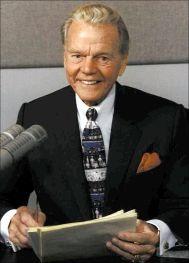
Some of us can remember Paul Harvey, the renowned radio announcer who came on the air at about 12:05 pm on Saturday, after the top of the hour news.  In the next fifteen minutes, he told an amazing story without divulging the name of the principal subject, and in such a way, that those casually hearing the news actually stopped what they were doing to listen.

Zenith AM FM Radio

I can remember every Saturday at the gas station where I worked in 1977-1979 how we turned up that old AM radio, which was covered with greasy fingerprints, while eating lunch and taking a break from oil changes, tire repair, and pumping gas.


Paul Harvey At MikeThe story always ended with the big reveal of the person who experienced the events.  You could never expect the ending.  Not in a million years.   At the last possible moment, Mr. Harvey would intone…”and now, you know the rest of the story” as he signed off.
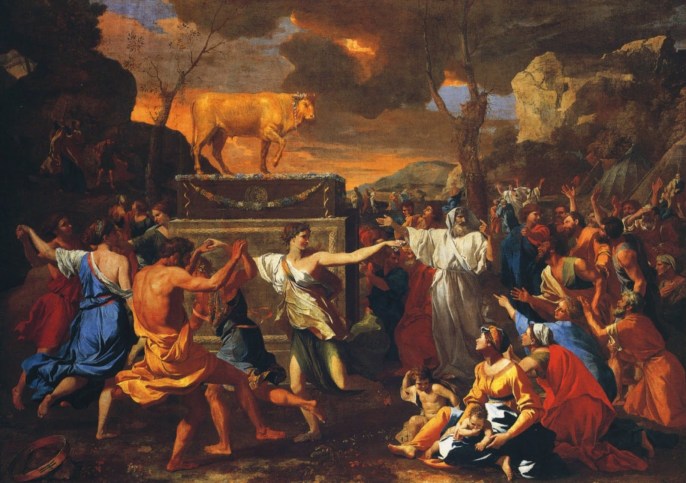


If we read the Old Testament, like a book, at times the stories from one chapter don’t make sense at first.  In Exodus 32, we read of the tribes of Israel rebelling against God, while Moses was on Mount Sinai, and his brother Aaron the high priest actually creating the idol of a calf for worship.

Nicolas Poussin The Adoration Of The Golden Calf We all naturally wonder how God would ever permit Aaron to take one more breath, with that kind of sin.  We struggle to understand God…His apparent forgiveness…for something so bad…and specifically, it seemed, for Aaron.

But, many pages later, we’ve moved into a very interesting passage, one where Moses himself is speaking to the tribes.  Imagine, if you will, Moses being on the air on that old AM radio, like Paul Harvey, and all the tribes gathering around to hear him.  The stories are retold, but this time, in the first person.  “I fell prostrate before the Lord…” and “So I made the ark out of acacia wood…and I went up on the mountain with the two tablets in my hands.”  The personal recollections speak powerfully to us.

And, in this passage, we read something of great importance.  It is, if you will, the rest of the story.  Look at Deuteronomy 9:20

“And the Lord was angry enough with Aaron to destroy him, but at that time I prayed for Aaron too.”

Wow!  What seems at first to be most confusing, yes, even concerning, now becomes clear.  God in his righteousness wanted to express His valid judgment against Aaron.  God in His holiness had every right to destroy Aaron.  Moses, in his position as both God’s leader and Aaron’s brother, had a terrible realization that he loved God, and yet he loved his brother too.  Can you imagine the conflict he felt inside?  We can’t know what Moses prayed, but I imagine it was words recognizing both God’s holiness and judgment, and Aaron’s shortcomings and humanity.

So we see that God remained God, throughout this time.  Aaron, a high priest, experienced a restoration through repentance, yet also was punished in accordance with his sin.  God in his sovereignty chose, on His own, to forbear Aaron’s sin, to provide absolution, and to use Aaron for many years in leading the nation in worship and adoration.  Moses learned time and time again that prayer allowed God to show Himself, His true nature, His power, His holiness, and His faithfulness to His chosen people.  Prayer didn’t change God, to be sure.  Prayer changed Moses.

Read God’s Word!  Trust that God will never change, and that He will reveal Himself to you in your time together.  When you find something that doesn’t make sense, allow it to be a time of learning.  Pray.  Pray like Moses did.  And in time, God may give you a chance to share with your tribe the faithfulness of God in your life.

Fitness From Frailty

As I age, I find my mind thinks I can do things my body can’t do.  And, my body tries to do things that it can’t do.  At times, the body says “hey boss, we’re not doing that today.”  At times, the body tries to keep up with the mind, and afterwards, complains “we are NOT doing that again, and I’ll be needing one aspirin, one ibuprofen, AND one naproxen sodium — NOW.”fullsizeoutput_28ec

We all live in our eternal youth, and about halfway through life on earth, we realize that some physical challenges are not easily surmountable.  The fifty-pound luggage we so cautiously lift into the trunk, the thirty-pound bag of dog food we carry to the car, and even the moving of a truck bed of mulch can bring us to our recliners with a groan.  I realized at 55 years old I needed to recover from two decades of sloth.

A friend who volunteers with me in the local police force asked me to consider a novel fitness program, one based on military team activity, yet including other elements of strengthening.  It’s called X-Team Fitness.  The program offered a six-week “boot camp” for a reasonable price, which included before and after measurements of health and fitness.  For some reason, perhaps the fear of my future demise, I decided to accept this challenge.fullsizeoutput_28ed

Six weeks?  I can do this.  How hard can it be?

The physical fitness assessment began one warm Sunday afternoon, with six others joining the “boot camp.”  There, blood pressure, pulse, height, weight, fat content, body mass index, and a 3D physical image were taken.  Along with the medical measures, I managed a couple of pull-ups in the gym.  The following day, I struggled to perform two minutes of sit-ups, two minutes of push-ups, and a 1.5 mile run on a local track.  Boy, am I out of shape!

So it began.  Six weeks of training.  The next day, I joined about two dozen others at an outdoor park where we engaged in light calisthenics before the leader charged off at a brisk pace.  Soon the two dozen were spread out from one end of a bridge to the other, all running at some pace, but some clearly running.  I was at the back of the pack, in my orange “candidate” tee shirt, with my name on the left chest.  “Back to last” came the call from the leader, and I saw the faster runners heading back my way, and turning around again as they reached the back of the pack before zooming away.   So that’s how the group stays together, I thought.  I don’t like being last.fullsizeoutput_28f1

Bring it in” I heard over the cars passing by.  The group circled around our leader, and we were given a series of interesting exercises to attempt.  After a short session, we returned to running.  And exercising.  And running.  Many of the exercises were new to me, and all were challenging physically.  I could perform at most half the number of them, compared to the others.  I checked to see how the other candidates in orange tee shirts were doing.  Most of the time, we were all bent over after our attempts, heaving deep breaths, or plodding slowly at the back of the pack.

The next day, more of the same.  At another park.  With other challenges.  Some faced as a small team.  Some faced alone.  More running.  More crunches.  More mountain climbers.  More of just about any way to move my body into positions I hadn’t been in since sophomore year of college, as fast as I could move, as many times as I could do it.  At the end of the week, an indoor day at the gym.  Weights.  But not just weights.  Weights in a circuit of training that included all major muscle groups.  Which were all hurting.

Six weeks?  Six weeks of leaving work late, dressed in workout gear? Six weeks of meeting at 6 pm, at places around town I had never been?  Six weeks of daily one hour workouts?  Why is the leader making it so hard?

Each day, I returned home at about 7:30 pm.  Each day, I faced fourteen more steps to climb, to slowly make it to the shower upstairs.  Each step my legs cried out to take it easy.  Your legs would cry out too, if you had to carry a 170 pound man on your back up and down a 10 yard hill.  Yes, that was one of the many exercises we did from time to time.  Dinners were late, and I didn’t have much appetite.  The washer and dryer ran on overtime, cleansing the sweat from that orange candidate shirt every day.  I found myself in bed early.  I had to buy two bottles of pain killers.  Good thing they were on sale.

Six weeks of this.  What am I getting at the end of six weeks?  A black tee shirt?  The one that says “Member?”  That shirt became very important to me.  I saw others in the group wearing theirs.  I saw the name of the group stylishly imprinted on each.  I wasn’t allowed to wear black.  I wasn’t part of the team.  Yet.

During the six weeks, I faced physical challenges that were daunting.  In time, though, I realized my biggest challenge remained within me.  Did I want to go through with this?  How could anyone do this stuff?  Are you kidding?  It hurts!  Don’t you realize it hurts?  You want me to run up how many steps on this hill?  152? Twice?  At least?Libby_Hill_Stairs_Diagonal_DMH3104

I’m doing alright here.  I just need a little time to get going.  I’m old.  I’m not supposed to be able to do this, like those young kids running with me.  And this weight lifting?  I am totally confused.  How am I supposed to do a “hack squat?”  This seems risky to me!  Many times during the first few minutes of a workout I thought “I’m just not doing this.  I’m leaving.  I cannot lift 50,000 pounds in 45 minutes.  This is insane!”

For a few weeks, I suffered along.  Workouts became easier, in time. The camaraderie of the group brought life to the effort.  The shared physical challenges brought us closer together.  I don’t know if you’ve ever performed a set of sit-ups as a line of Radio City Music Hall dancers might, arms interlocked and moving in unison.  I have.  It’s hard!  But, working together like that brought me to a greater effort level, not wanting to let the group down.  Many small team exercises like this made the hours go by with more meaning.

Week 1 over.  Week 2 over.  Week 3 over — hey, I am doing this!  Week 4 — the sun is nearly down and we’re still doing it.  But what a great opportunity to exercise along the James River…IMG_3360

Week 5 — the sun is down, it’s cold, it’s raining, and we are still doing this.  Only sixteen of us, but we are out here.  I realized that I was reaching the point of decision.  Would I continue?  Would I be part of this team?  In Week 5, the experience felt like dating a very beautiful girl, but a girl you wouldn’t take home to mother.  There was something about the girl that just wasn’t right for me.  In that week, I was convinced that I’d have to tell our leader that I was grateful for the six weeks, the improvements I’d made, but I would have to do this on my own now.  I rehearsed the speech many times.  It would be hard telling someone you don’t want to continue.

Week 6 came.  I had to make every workout, to meet attendance requirements.  Monday was an indoor day.  Tuesday back outdoors.  Wednesday was yoga at 6 am.  Thursday, back outdoors, at 6 am.  Thursday was hard.  A lap of the 400 meter track, an exercise, another lap, another exercise, and so on for ten exercises.  I was whipped.  I was last, but I finished.  In the finest military tradition, the team rallied around me, even our leader, and helped me run to the finish line in a near sprint. Friday indoors, 6 pm, with two seven-exercise circuits.  Small teams, working together.  I got to call the exercise counts for the entire cohort.  It felt good.  I left, knowing I had made the six weeks.  I would have cried, except the sweat had taken all my tears.

The next day, I had to carry my wife downtown to a medical training course.  I realized that I would be near one of our workout places, and I wanted to do a little workout to ensure that I would perform well at the fitness evaluation on Sunday and Monday.  I parked near Belle Isle and walked down there with my dog Sandy.  We crossed the bridge to the Isle, took a few pictures, then began jogging.fullsizeoutput_28c1

It felt good.  After making it around the Isle, and back across the bridge, we jogged up the very steep road called Brown’s Island Way that was part of at least two workouts before.  It was hard. Still.  But it was not the same.  I was alone.  I was on my own.  My pace was slow, and the energy within was low.  The team would have made a difference.

And then, the evaluation on Sunday.  Weight, body mass index, and pull-ups.  I prayed for pull-ups.  Four pull-ups.  I wanted to show some improvement on this, my biggest strength challenge.  The measurements of body fat lost, muscle and size gained, were energizing.  I made four pull-ups and hung on the bar for 58 seconds.  Progress!  Monday at 6 am, the test.  Another “team orange” member partnered with me, and we went through the push-ups and sit-ups.  The run followed, and I could tell I was faster.  The group dashed to the gym, where graduation ceremonies were scheduled at 7 am.

There, my improvements were lauded.  I doubled my pull-ups.  Doubled my push-ups.  Doubled my sit-ups.  Cut two minutes from my run time.  And, there, in our leader’s hand, was my black tee shirt.  The shirt I’d wanted for six weeks.  Folded neatly.  Logo visible.  With a custom certificate of completion, recognizing “I pushed, I adapted, I overcame.”  I smiled broadly as the group applauded.fullsizeoutput_28d2

Over the next few days, I realized the journey I’m on isn’t over.  It began with a mantra of “I can’t!”  For weeks I made that statement.  Quietly.  Silently.  But I said it.  About halfway through the pain, “I can’t!” became “I want!”  I wanted to make it through the entire six weeks.  I wanted to make it through the pain in my knees, my shoulder, my arms.  I wanted the black shirt.  That want drove me to a measure of success.  But, in Week 6, I realized I had changed inside. No longer “I can’t” with fear of failure looming over me.  No longer “I want” as I was certain I could make the six weeks.  It was “I will!”  I will do this!  I will push myself.  I will continue.  I will attack the challenge.  It’s a real difference, for me.  It’s a change in how I look at my abilities.  And, in time, I think I’ll smile as I face them with a new recognition — “I can!”  In time, I can see myself smiling as I scramble up a near vertical rock face at Byrd Park down at the Pump House.  I can see myself truly dashing up 152 stairs at Libby Hill, enjoying the view from the top, and heading down to do it again.  “I can!”Libby_Hill_Fountain_Top_DMH3092

Today, there is only one “I can’t” left in me…but it’s different.  I’m heading to a place of personal growth and extreme fitness.  I’m heading to a life with health and wellness.  It’s not “I can’t.”  It’s “I can’t WAIT.

Am I Serving?

In blog posts on Luke 9, we have considered three questions so far.  “Am I Radical?” , “Am I Following?”  and “Am I Proclaiming?” We’ve looked at these teachings of Christ as Luke describes the movement of a group of disciples from Samaria to Jerusalem.  We can only imagine what it must have been like to be in this group, and to realize that we have a chance to speak with Christ the Teacher.  Now, let’s finish the journey by studying perhaps the most difficult verses:

61Still another said, “I will follow you, Lord; but first let me go back and say goodbye to my family.” 62Jesus replied, “No one who puts a hand to the plow and looks back is fit for service in the kingdom of God.”

Why are these two verses so troubling?  I think it is only natural, as we all face the three elements of verse 62.  Do I want to serve?  Have begun to serve?  Have I stopped serving?  Oh boy, I am not fit to serve any more!  Sadness, fear, uncertainty, or disappointment in oneself could follow.

 
Another point of concern is the apparent linkage of following Christ and not being a part of your family from that moment on.  Christ’s response sounds harsh – are disciples not permitted to speak to their family?  Are disciples not permitted to visit their family?  Why is Christ concerned about a person following Him and remaining in the person’s family?

Let’s review the entirety of the passage again, briefly, so we can fully appreciate verse 62.  Jesus has been transfigured.  Christ has healed the sick.  Jesus has predicted His death.  Jesus is moving through a people group normally antagonistic towards Jews, and has experienced some hostility there.  Jesus has prevented his disciples from acting in anger towards that people group.  Now, he is on the way to His crucifixion, and leading a group of men who are declaring their allegiance to Him.  In this context, Christ is speaking with individuals who make a discipleship decision – to follow Christ.  Are we in that group?

Now, in verse 62, it is helpful to check the original Greek text verb tenses to understand the word picture in its entirety.  The verb for “puts a hand” is aorist tense, a past complete action.  The verb for “looks back” is present tense, a current continuous action.  We see a one-time decision to believe in Christ, “puts a hand to the plow,” but a continuing action of “looks back” after that decision has been made.  I wish we didn’t have to “look back” at Greek but sometimes it really helps!

We read in Mark 10:28-31 a heartfelt cry of devotion that mirrors the what we read in Luke 9, the man’s plea to go back to his family.  The disciples lament, in a way, what they have done for Christ:

28Then Peter spoke up, “We have left everything to follow you!”  29“Truly I tell you,” Jesus replied, “no one who has left home or brothers or sisters or mother or father or children or fields for me and the gospel 30will fail to receive a hundred times as much in this present age: homes, brothers, sisters, mothers, children and fields—along with persecutions—and in the age to come eternal life. 31 But many who are first will be last, and the last first.”

Today our missionaries see what happens to families when individuals make decisions for Christ.  Do their families come to rescue them from a “bad” decision?  Do they leave their families?  Are they shunned by their families?  Can they return to their families, often hostile to our faith?  And, to be more complete in our view of families and the person’s relationship with them after making a decision for Christ, we can look at Mark 5:19 where a man is told by Christ to return to his family to witness to them.  In Acts 10:24 we also read of how a righteous man brings Peter to speak to his entire family, resulting in their salvation.

So, we can see in Christ’s admonition to this man who wanted to return to his family Godly wisdom and direction.  It is not so much that Christ wants the man to leave his family, or to prevent him from witnessing to his family.  But, it is that in following Christ, we are to avoid losing focus as we return to old ways, to old customs, and to old beliefs.  We are to be new creations, to be His disciples!

A friend of mine was on mission in a developing nation, and was given the opportunity to plow a field just like they had done for hundreds of years.  The plow was pulled by oxen, which were led by a young man.  The plow had to be forced downward into the ground to bust the soil.  That’s some hard work!

web_Oxen-hooked-up-to-chisel-plow-an-oxen-powered-ripper-March-5  As my friend plowed, he naturally looked backward to see how he was doing.  Before long, the plow was well off the intended line, and everyone was laughing at the result.  We can laugh with my friend, as we think about what it must have been like to try something new.  But, we can also see why Jesus chose this word picture for people who seek to serve Him.  If we want to serve, if we take on the job for which He calls us, we can never lose focus on Him.  When the plowman looks back, the results of his service are not what Christ intended.  The furrow that is not straight can’t be used.  The seed that Jesus wants to plant in that field can’t be sowed. And the harvest Christ hopes for must wait.

Let us not forget the work for which we are called (Luke 9:60).  We are to plow a straight furrow in proclaiming the kingdom of God!  Remember the meaning of proclaim — we are to make a loud noise about a kingdom that we belong to now, and that is to come in great glory in the future.

As disciples of Christ, let us focus on Christ as we plow, and never look back!  Let us answer the question “Am I serving?” with a simple exclamation —  “Yes!”

Am I Proclaiming?

In the blog post “Am I Radical” we considered how each of us might be more like a first responder to an emergency, where the emergency is the eternal status of a friend or acquaintance.  In the post  “Am I Following” we wonder how to respond as Jesus challenges us to GO on His behalf to a fallen world.  Going to our world, we read an interesting command found in Luke 9:60:

60 Jesus said to him, “Let the dead bury their own dead, but you go and proclaim the kingdom of God.”

What comes after “go?”—“proclaim the kingdom of God.”  The more I thought about it, the more interested I became in the meaning of the command.  Most likely, we’ve all rushed over these words and thought “yeah yeah, proclaim the kingdom of God.  Got it.”

Let’s take a look at the command in more detail, as is fitting for such an important instruction.   As a church worship band might wrestle with chords, phrasing and timing for a new song, we must take time to learn something new.  God’s Word deserves nothing less.

“Proclaim.”  That brings to mind an immediate movie scene or two, don’t it?  “Hear ye, hear ye, … , “ as the town crier unrolls a parchment scroll and reads some order from the king.  What does the word really mean, though?  At first, I thought it might be from “pro” and “claim.”  You know, pro, like “for” and “claim” like “it’s mine.”  Let me tell you, I am NOT a linguist.  Not even close.  The simple view of the word from its Latin origin is found online:

proclaim c.1400, from L. proclamare  “cry or call out,” from pro-  “forth” + clamare  “to cry out” (see claim). Proclamation  “that which is proclaimed” is recorded from 1415.  Online Etymology Dictionary, © 2010

I like it!  “Clamare” sounds a lot like our word “clamor” which is what worship band drums sound like sometimes.  Noisy.  Loud.  Energetic.  Attention-grabbing.

500px-Terry_Bozzio_drums
But of course, the online dictionary of the English language is not a perfect Biblical analytical tool.  Looking at the different translations of the same source text can give us an idea of the meaning of this important word.  Here are a few of the words synonymous with “proclaim:”  Publish, tell, preach, announce, give news of, and spread – all words trying to convey something that in Latin makes the most sense – “to cry out!”

Of course, we are to be noisy about “the kingdom of God.”  So we have to truly seek its meaning.  And, we have to recognize that Christ Jesus gave these words as if the man walking alongside Him would easily grasp the meaning.  It was not a long sermon!  Go, proclaim the Kingdom!  What did He mean?
It is interesting if you do a phrase search for “kingdom of God” using either the old-fashioned concordance or a modern online resource like http://www.biblegateway.org.  If you place quotes around the phrase, seeking an exact match, the first reference is…drum roll, please…in Matthew.  Many topics are found throughout the Bible.  This concept , the kingdom of God, appears to be solely in the New Testament.   We can read Luke 16:16 to be sure:

“The Law and the Prophets were proclaimed until John. Since that time, the good news of the kingdom of God is being preached, and everyone is forcing their way into it.”

Now, describing the kingdom of God is difficult.  Scholars do debate and discuss its essence.  Reading the verses about it just in the Gospel of Luke, we can see some of its many attributes:

It belongs to the poor [Luke 6:20]
It is a place of ranking [Luke 7:28]
It is good news [Luke 8:1]
It is near Luke [10:9]
It is like a strong tree [Luke 13:18-19]
It is like a tiny organism that can’t be stopped [Luke 13:20-21]
It is a place where the patriarchs and prophets exist [Luke 13:28]
It is a place of all peoples Luke [13:29]
It is a place of feasting Luke [14:15]
It is not something to be observed [Luke 17:20]
It is now [Luke 17:21]
It is a belonging [Luke 18:16]
It is received by childlike faith [Luke 18:16]
It is difficult for some to enter [Luke 18:24-25]
It is to come [Luke 22:18]
It is worth waiting for [Luke 23:51]

We could continue reading all the references and continue to be amazed!  I can only sit here and wonder “how am I going to proclaim all of this?”  I can’t even understand some of it!

I guess we can take heart in the way Christ spoke of the kingdom of God.  Did He offer all these descriptive words at once?  Did He try to cover the entire subject in one lecture?  Did He drop a few drachmas at the local Fedex Office store to make copies of His latest manuscript to hand out to the followers?

No, of course not.  Jesus spoke of the kingdom of God just as we should—ministering to those in need, as they needed.  He spoke simply.  He spoke clearly.  He spoke in ways that made sense to each person that asked a question.  Let us think deeply about the meaning of the kingdom of God, so that we do understand as much as we are able.  But, may we be ever more like Jesus as we “cry out” about His kingdom!

Am I proclaiming?