Like many homeowners, I finally broke down and broke out a few dollars to renovate my downstairs. It was 2021. Not a good year for more than one reason. But, for a while now, we have enjoyed our “new” downstairs.
In the renovation, we purchased all new kitchen appliances. Very advanced models, WiFi connected, quiet, and fully featured. However, one appliance seems to have a mind of its own. It is the dishwasher.
Over the past months, we’ve had numerous occasions to power cycle the dishwasher to break it out of a non-stop beep bop whistle flashy lights mode. Sometimes it happens, but of late, it seems to be rarer. Unless the cook has been power cycling behind my back. Which she probably has.
More recently, a distinct whine has been heard. It started faintly, but grew in volume and duration. Now, it is a non-stop electromechanical sound. You just know this is not good.
Since the chief cook is now required to be the bottle washer too, I decided to investigate. In my new role as a retired engineer, I have taken tasks like this on with more patience and no curse words. I try very hard to just do enough to diagnose and repair. Instead of pulling the dishwasher out of the cabinet area, and poking around various high-tech and low-tech subassemblies, I took things slowly.
First, I made sure the drain was free from debris and that the dishwasher was able to pull water out of the cabinet and into the pipes. No issues there. Having had to repair the drain pump before, when a tiny metal pivot pin fell out of a cheese grater, I was hoping the drain motor did work well.
Now, with the noise still obvious, I decided to look at the circulation pump. Inside the cabinet, I took out the racks, the four-arm spinner, the drain screen and panel, and then look at the central water area. Nothing. No dirt, slime, grit, anything. I even was able to rotate the pump motor from above, just a bit. And best of all, I did NOT drop any screws into the drain sump!
Now what? As my favorite and first boss Kenneth Cunningham of Cloverleaf Servicenter would say “I’ll tell you whut…” Kenneth could always tell a story with a grin that exposed a few ounces of Redman tobacco. In today’s world, where I can’t call Kenneth to ask for advice, I decided to try ChatGPT.
I’ve been using ChatGPT with great success lately. Working on some big datasets, analyzing those columns for their possible effect, I’ve found AI can certainly write scripts to allow the computer to do the simple tasks like deleting columns, creating new columns, evaluating entries against numerical limits, that sort of thing. It’s been so helpful, to have time to think about the data, to model it, and to get answers from it rather than ponder how to write code in a new computer language. Old dog, new tricks? Not gonna happen. But, with ChatGPT, the old dog is definitely doing new tricks.
So I inquired of ChatGPT what might be making a dishwasher noise. It’s a computer, but it is much like Hal from 2001 A Space Odyssey. It writes back to you as if it is a person. Sometimes I even find myself saying please and thank you to a computer. That I pay a monthly fee to do what I tell it to do!
ChatGPT, in a flash, suggests a few possibilities. Then it says “or you can upload a short audio clip…and I’ll identify the sound source for you.” As John McEnroe famously said “You cannot be serious!”
Having put the dishwasher back together, I pulled the iPhone out, and told Sandy The Little White Dog to be quiet. I started the dishwasher up, and hit the record button on the iPhone Voice Memo app. After the initial sump clearing noise, the offending whine started. I then made another recording of just the whine sound.
Back at the MacBook Pro M4Pro with 48GB of RAM, I discovered those files in my iCloud account. Being .m4a file type, I was not hopeful that ChatGPT could “listen” to them. Sure enough, I had to learn how to use Apple Music to import and convert the .m4a to .mp3. Trivial, but certainly silly, for Apple to be so provincial about sound files. At least Apple has the convert utility inside the Music app, and I don’t have to purchase software.
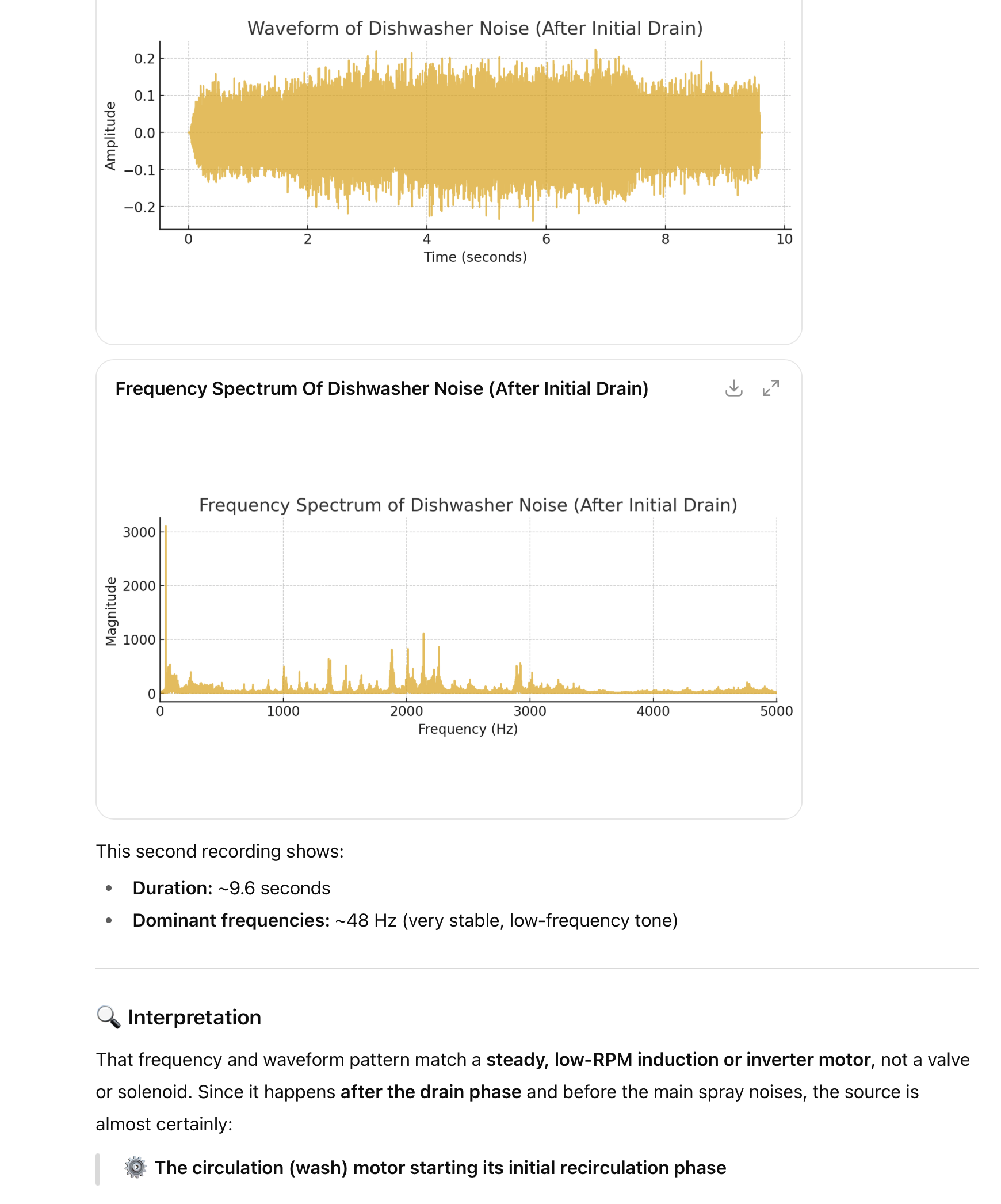
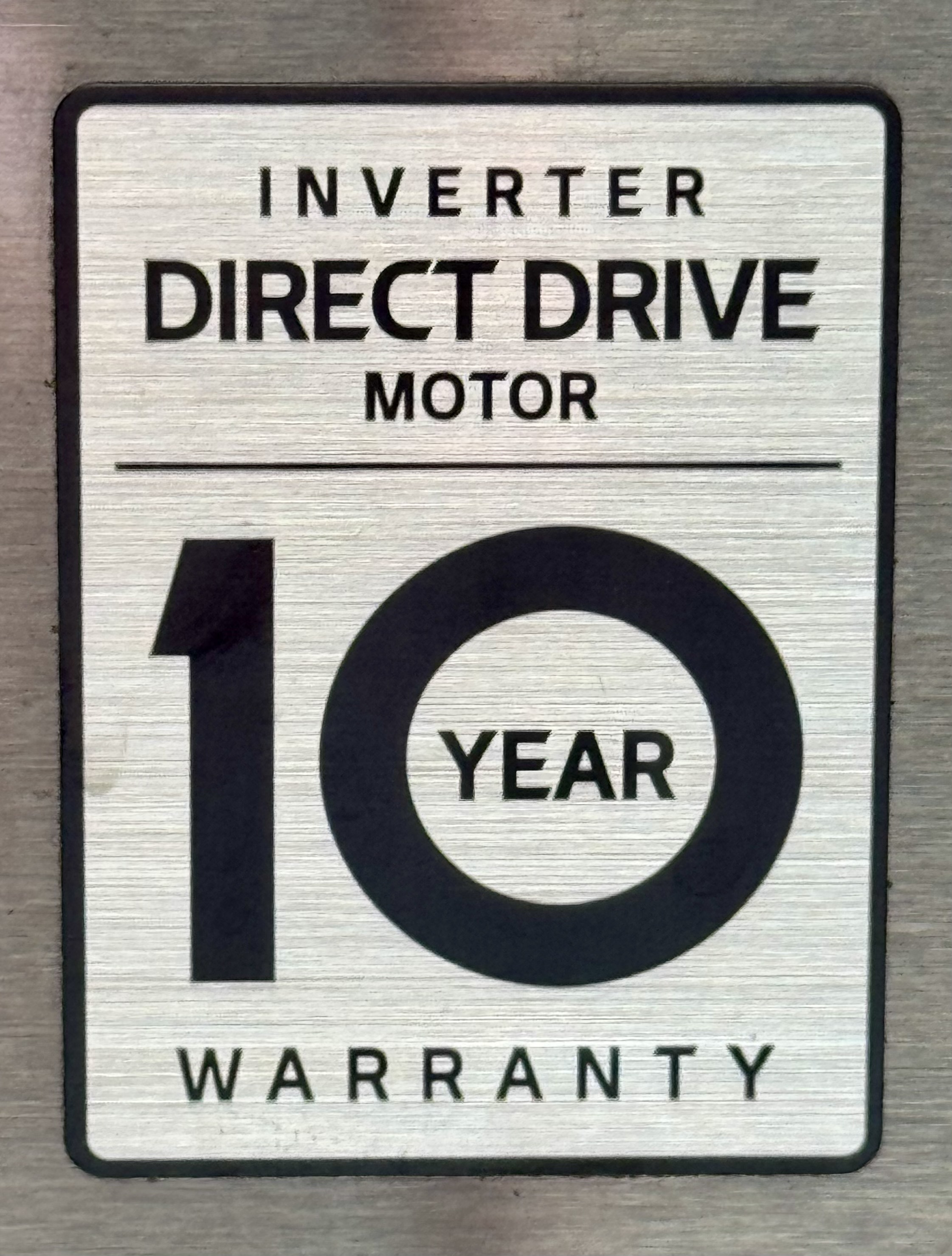
Back to ChatGPT. I uploaded the first sound file. ChatGPT correctly interpreted the dishwasher operation cycle. It knew that the first sound was the sump drain pump motor, and the second sound was the circulation pump motor. Wow! I then uploaded the second file, of just the circulation pump motor. ChatGPT, in literally two seconds, presented me with a full analysis of the sound in both frequency and time domains. It even knew, from the frequency, that the pump motor is the inverter type (so says the dishwasher door, on a spiffy badge glued thereon.). How in the world?
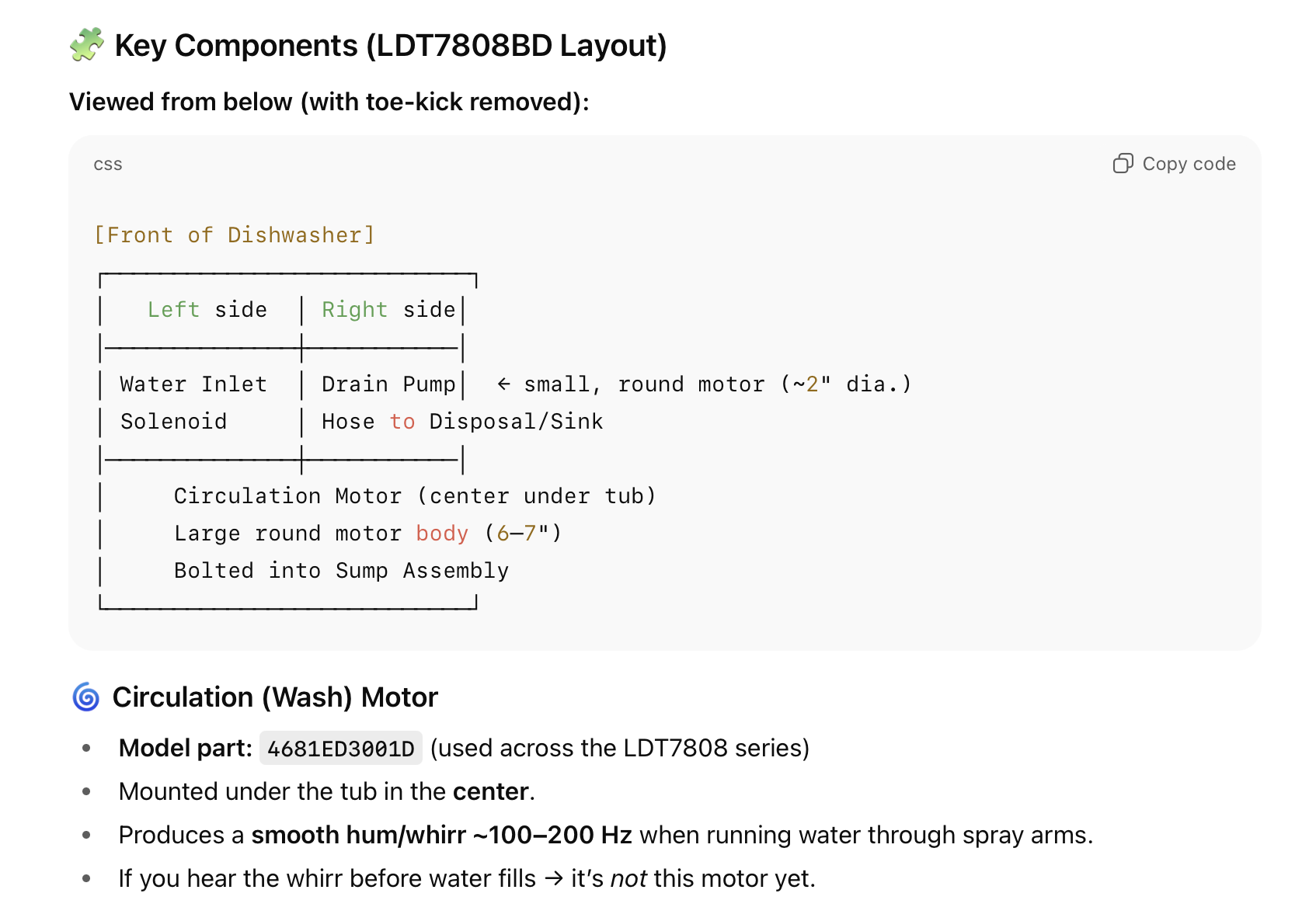
The AI even knows the motor part number…
So, with a ten-year inverter motor warranty (so says the dishwasher badge), I wrote the manufacturer a nice e-mail. I included the .mp3 file and the ChatGPT analysis and conclusion. I hope they send me a new motor. It would be nice if they send a repairman to install the motor too. We’ll see.
I am amazed at the utility of ChatGPT. How in the world can it have such insight from information found on the WWW? How can it know the frequency domain of an inverter motor? How can it differentiate between a drain pump motor and a circulation pump motor? Who told “it” these facts about two different motors on a common dishwasher? Who gave it a language interface that I can understand? Who knew it needed to create graphs to convey facts visually? How did it know to analyze a sound file in two “dimensions” and show both to me?
I haven’t given ChatGPT a name yet. Hal is already taken. And Hal was mean. Alexa and Siri are in widespread use. Maybe someday I’ll choose a name for it. I remember how hard it was to choose my younger daughter’s name. We wanted it to be perfect. For ChatGPT, I just need a moniker. The more I think about it, the more I think “Isaac” might be ideal. Mr. Newton was no intellectual slouch. He knew more about more than anyone. I think ChatGPT may someday surpass even his vast factual knowledge.
It began when Kathryn Leigh found Tink the Truck failing to start, failing to be a reliable 1995 Ford F150, soon after her nuptials. Paying $15 each way to catch a Lyft to work on a yeoman’s salary for a week, or bumming rides from coworkers, was a problem. Paying $400 to a mechanic to fix Tink, only to find Tink not fixed, was even worse. Being a newlywed, and facing the unknown of ongoing Tink maintenance, and the extraordinarily high gasoline cost at only 10 mpg, Kathryn and Ian decided to stop driving the 23-year-old treasure and to purchase a new Nissan Kicks, a tiny SUV with 31/36 mpg. Tink the Truck needed to find her way back to Richmond. Dad?
So, Dad decided to make it all happen, as only Dads could do. I called a friend with a trailer, and begged for a window of time to drag Tink back to Ashland. Friends being friends, a plan came together. Start early, finish before the friend’s wife and kids knew what time it was, and continue on with the day of hockey games and other holiday family events. I grabbed the best breakfasts McDonald’s could make for the two of us and headed over at oh-dark-thirty Sunday morning.
Filling up the Suburban, hooking up the trailer, and getting to Newport News was easy. We shared stories of work, life, and some dreams of RV life. As expected, we made it to the newlywed’s apartment by 8:40 am. There was Tink. Thankfully the apartment had a ring road, making it possible to align the Suburban and trailer with Tink and not block anyone, and make it out of the complex without backing up.
Ramps from the Bri-Mar trailer were pulled out, and magically on a very warm morning, Tink started. This was great, since winching a vehicle up onto a trailer is so much more challenging, especially with an inch to spare on either side. With some guidance, Tink was driven up on the flatbed. It was not too difficult to get her up there and lashed down. I saw the new Nissan up close, and gave Kathryn a hug for making a great decision. The ramps were moved from the roadway back into the trailer, into their rectangular storage compartments under the flat bed. Spring-loaded ramp locks were engaged. The ramps were pulled and prodded to see that they were truly locked into position. I checked. My friend checked. Kathryn saw us check.
On the trailer, Tink’s weight showed us that one of the four trailer tires was low. Mighty low. We made our way to a 7-11 with a new computerized air dispenser. The notebook paper taped to the gizmo announced, sadly, that it was broken. Of course, this was only visible after making it to the gizmo, not from the road. Circling the parking lot, we made our way to a Raceway and found another air dispenser. Only $1.75! It used to be 25 cents. The tire, down to 35 psi, was slowly pumped up to 65 psi. The other three were bumped up a bit. And, Tink the Truck was on the road again, so to speak.
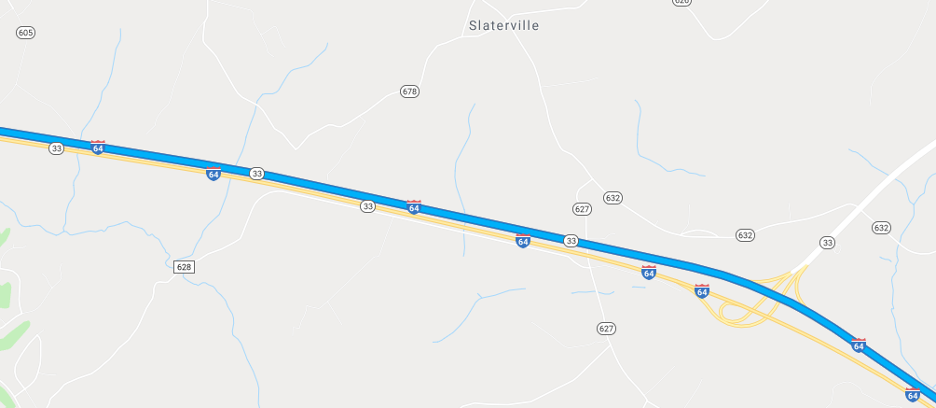
Construction on I-64 continues to vex all travelers, particularly those in Suburbans towing Bri-Mar flatbed trailers with 1995 Ford F150 trucks atop. Tractor-trailers meander into the travel lanes, jersey walls approach with impunity, and orange-white barrels announce repeatedly that traffic will be slow for many years to come. In amongst the paved and unpaved sections of the interstate, a few big bumps were felt. The trailer marker lights on the driver’s side went out, but the brake and turn signals were still working. On we went.
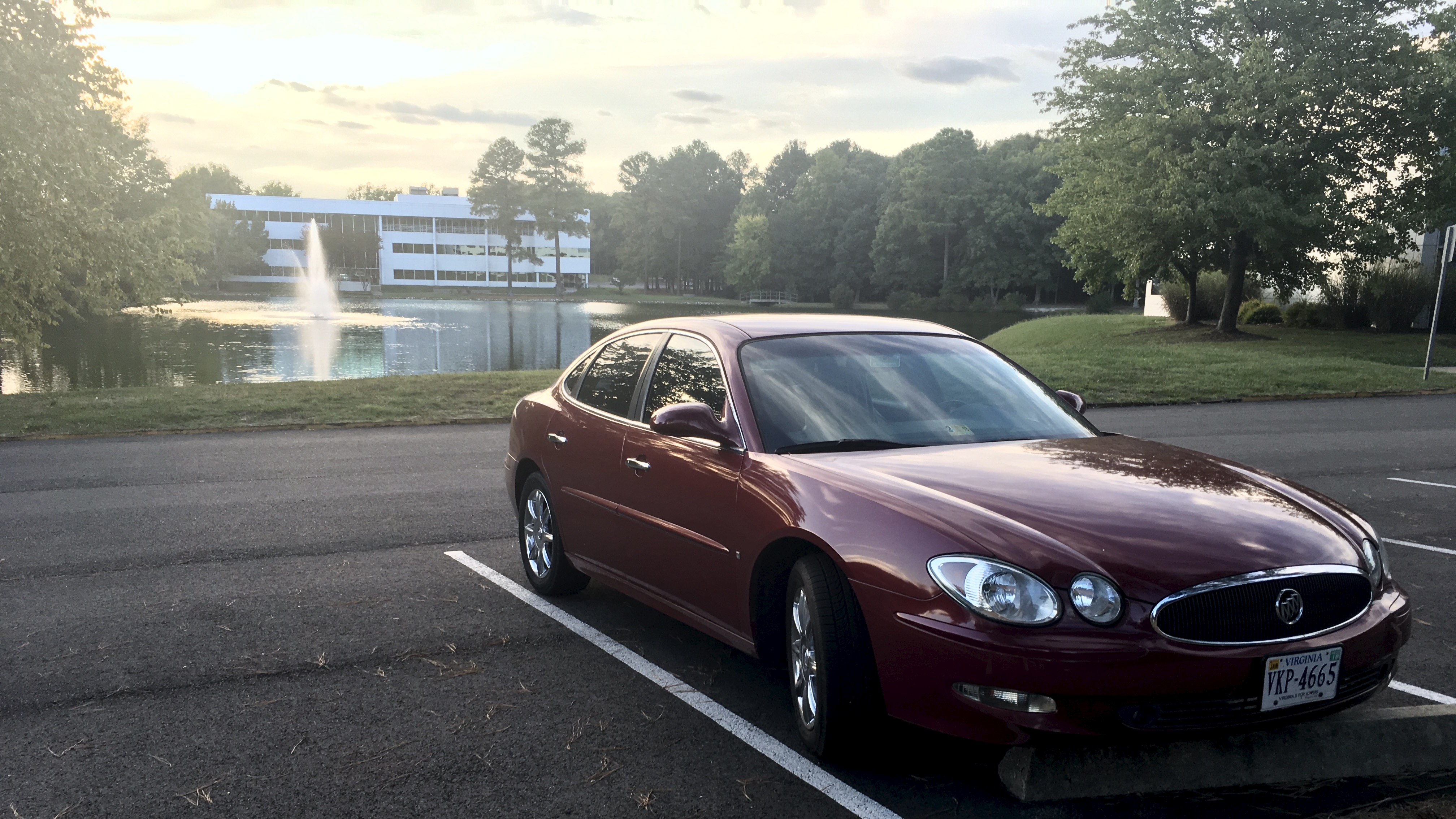
Once we made it to Ashland, some 72 miles away, we began the process of moving Tink to a parking spot. There, we saw it. Rather, we didn’t see it. We didn’t see one of the two ramps needed to unload Tink. The right trailer ramp escaped the trailer while pulling Tink the Truck from Newport News to Richmond. No idea how. No idea where. We did the only thing we could do, leaving Tink on the trailer. My friend returned me to my 2006 Buick LaCrosse, also known as the Red Sled, so I could head back to look for the ramp.
From the Short Pump area, I grabbed a simply awful McRib sandwich at McDonalds. My head hurt. My heart hurt. What was a great mission, was now compromised. Where was the ramp? How would we find it? How would I find it? Without a ramp, how would Tink ever get off the trailer?
I called my bride. She began searching the Waze app online for signs of debris in the roadway, or accidents. Nothing. I put the Red Sled into D for “drag” and rushed back to exit 250A and the apartment complex. I retraced our route carefully. I went to the apartment. I went into the 7-11 lot. I went into the Raceway lot. I followed the interstate westbound scanning for anything long and straight and black.
I thought I saw it, there on the right. It was long and straight, and looked a bit bent. The next exit, exit 220, was only a few miles to the west. I stopped there, gassed up, and thought about the situation. If that was the ramp, I needed my trunk empty. Better to do this here, than on the side of the interstate. I took the protective towel I use on the seat after workouts and put it on the passenger seat. I stacked the two milk crates full of water bottles and other travel junk on the seat, and the protein drink box in the footwell. I put my volunteer police bag on the front edge of the seat, balancing it against the dashboard. The umbrellas went between the transmission tunnel and the back seat. I folded the back seats forward, making the trunk as long as it could be.
I then turned around. I went back to exit 227, and turned back around to head west. I made my way back to the 224 milepost, and looked at the object again. Gatorback. Just a long tire cap, laid out lengthwise, looking like a ramp. But, I knew, I felt, I was certain, the ramp was near. I don’t know how I knew. I just knew. Just after exit 220, I found the ramp in the grass about ten feet off the interstate. Whizzing by at 65 mph, I was certain. I brought the Red Sled to a stop, and pulled well off the interstate. Hoping it was truly there, I popped the trunk open, just unlocked, but not flipped up. Hazards on, I was ready.
In my volunteer police bag, I have a garish neon green-yellow-orange safety vest. And, a pair of garish yellow kevlar-reinforced safety gloves. I reasoned that if the ramp were damaged, it might be sharp-edged. So, I pulled the items out of the bag and donned them. About 100 yards to the rear, maybe a bit further, I found the ramp. No signs of impact. No damage. No shiny scrapes. No idea how it made it ten feet off the interstate, into the grass. No idea. With my best imitation of a soldier pulling a wounded comrade to safety, I dragged the ramp to the Buick. In less than thirty seconds I had it back to the Buick, and in the trunk. Yes, the Red Sled trunk with seats folded forward can hold a 63 inch long ramp with ease. Not many cars can do this.
How the ramp left the trailer, we don’t know. The rough road and jarring impacts through the I-64 construction zones didn’t help, I’m sure. No doubt something sprung loose at the rear of the trailer just for a minute. Maybe the ramp slid out and down, and spiraled slowly away from the travel lane.
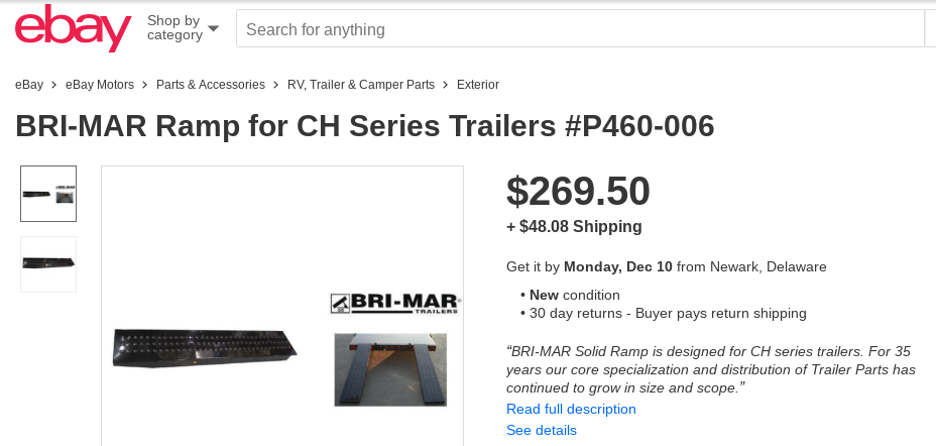
Looking on eBay for Bri-Mar ramps, I saw that a single ramp was $269 plus $48 shipping. I’m sure it is worth every penny, but I am also glad that I can put $269 into repairing Tink. It should be just enough for two fuel pumps and a fuel pump driver module, whatever that is.
I’m thankful for a friend who took time this morning to help. Thankful for 20/15 corrected vision to see items like this at 70 mph 10 feet off the road. Thankful for 16 years of police volunteer experience looking for issues like this, and training on how to stop and start on the interstate. Thankful for safety equipment on hand. Thankful for the Red Sled. Thankful for Godly prompts to be ready for action.
While thinking about purchasing a small car for my retirement, I couldn’t help but wonder if an electric vehicle would be right for me. I did some reading online. I did some searching. I saw dozens of ads on my social media feeds for various vehicles. I contacted VW dealers to find their heavily-promoted lease deal – and as you might expect, no vehicles matching the advertisement terms actually physically existed on a lot. So much for advertising. Dare I say “bait and switch?”
I decided to test drive a Tesla one Saturday. That was an experience. Our local dealer is much like an austere modern hotel lobby, with airport-like furniture, a welcome desk, coffee pod service, and three vehicles to see. With my appointment, I was able to jump into a Tesla in a few minutes of consultation from the consultant and see what all the excitement was about.
Let me tell you, Teslas are different. The style, the interior, the controls, the touchscreen, and the performance are all beyond the norm. I think that’s what Tesla wants—to be what I need, rather than what I expect. Zooming up an on-ramp, the dual motors brought me to extra-legal speed in complete silence. The cameras were amazing, presenting a new real-time view of my surroundings.
I checked on the Tesla insurance cost, with my independent agent. At my age, with my driving record, I expected a reasonable rate. I was glad to be sitting down at my computer when the quote came in. Three times the annual insurance cost of The Big White Truck or the Lexus RX350. Gee whiz! I keystroked all the figures into a spreadsheet (yes, I still use Excel spreadsheets even though I’m retired) to see what the monthly cost might be, for all of it. Lease payment, insurance, and the savings rumored to be possible with an electric vehicle all went into the calculations. It wasn’t what I expected.
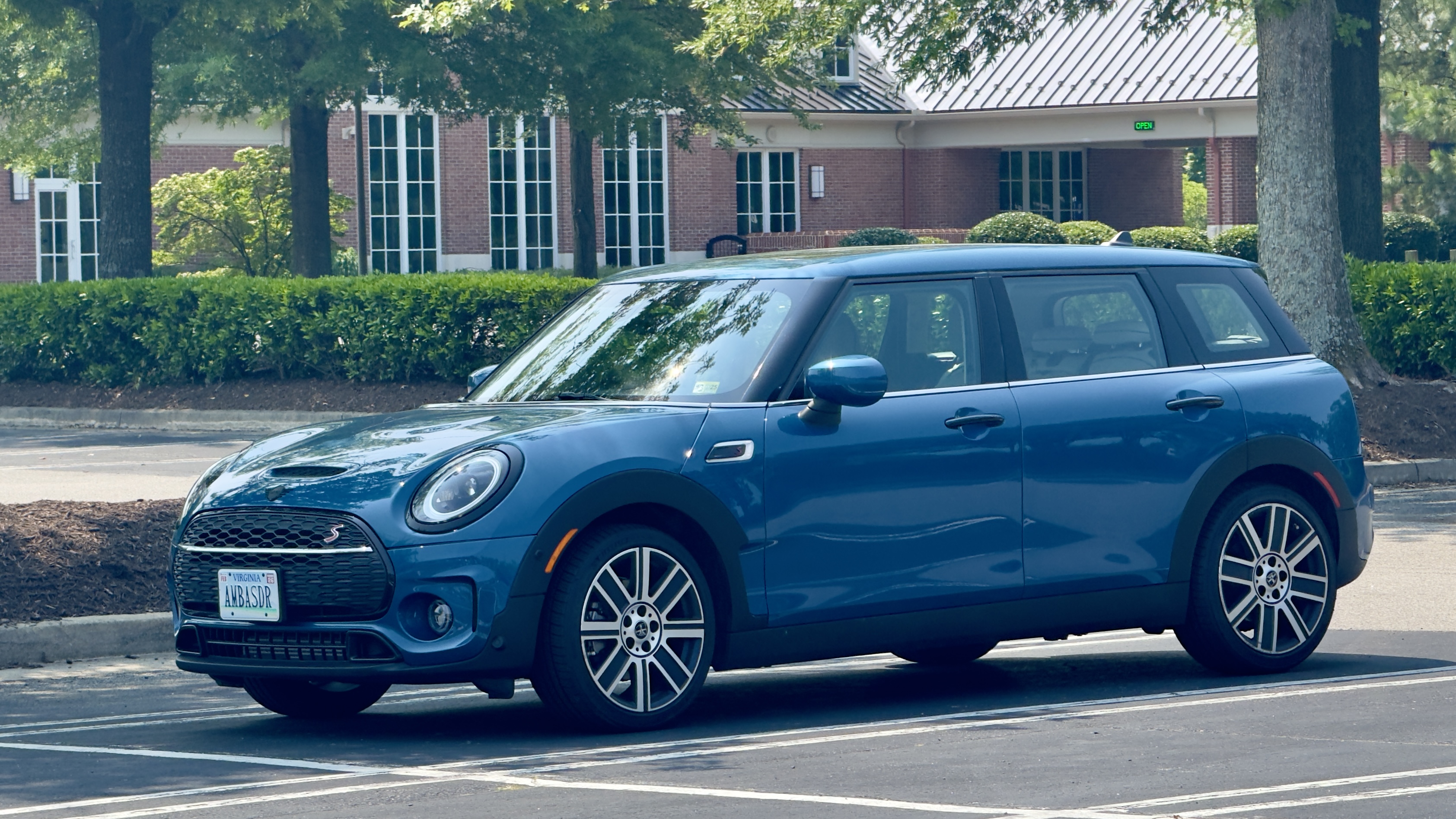
So, with that awareness, that careful study, I returned to the search for a vehicle that would excite my heart. I found it. A 2023 MINI Cooper Clubman. Absolutely perfect. Sea Island Blue, pale grey interior, 28K miles, factory warranty, extended warranty, new tires…it all made sense. I wrote the check and drove home with a big smile on my wrinkled face. No EVs for now.
But, I still wondered about electric vehicles. Could an electric vehicle work, as an in-town runabout? Researching travel plans for a trip to Fort Myers, I discovered that Hertz had a Manager’s Mystery Special on EVs. Only $144 for a long weekend? Sounded super, and best of all, I could really experience living with the EV.
We flew to Fort Myers, with the all-too-common airline delays. Leaving RIC was not going as planned. The AA app dinged time and time again, with new departure times. We were delayed so long we had only 30 minutes to traipse across CLT to the flight to RSW. And I thought booking a trip with a two-hour layover for lunch was perfect. Leave it to AA to make things exciting.
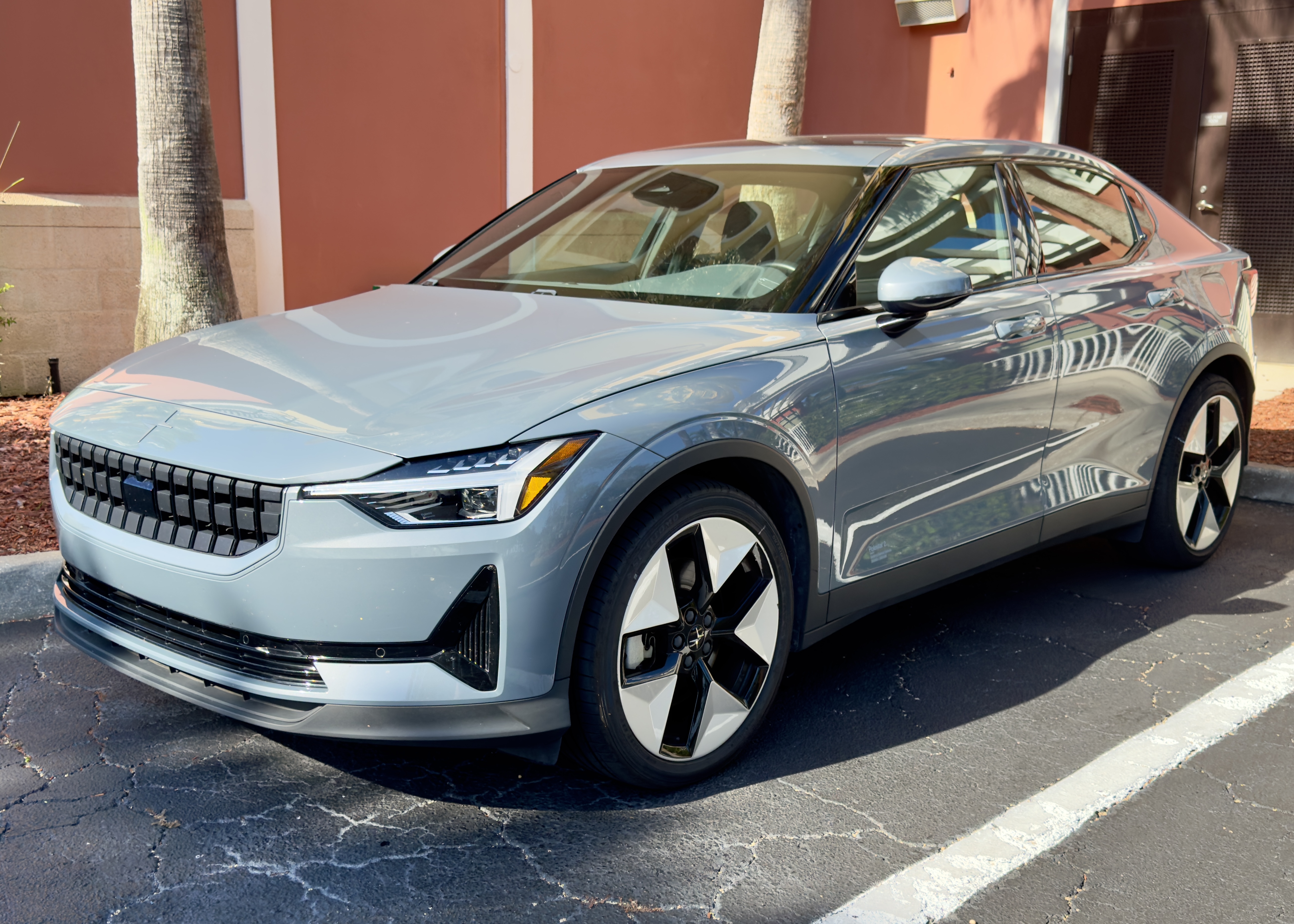
At RSW, at the Hertz lot, I looked for my car. You know, I’m in the Hertz President’s Circle so I get to walk all the way across the garage to my car just like you. I finally found the EV. Would it be a Tesla? Would it be uber-cool? In the darkness of the garage, we found it. It wasn’t a Tesla. Not a VW. Not a Subaru. It was a Polestar. A what? I know the polestar is the North Star, from my Boy Scout days. What’s a Polestar vehicle?
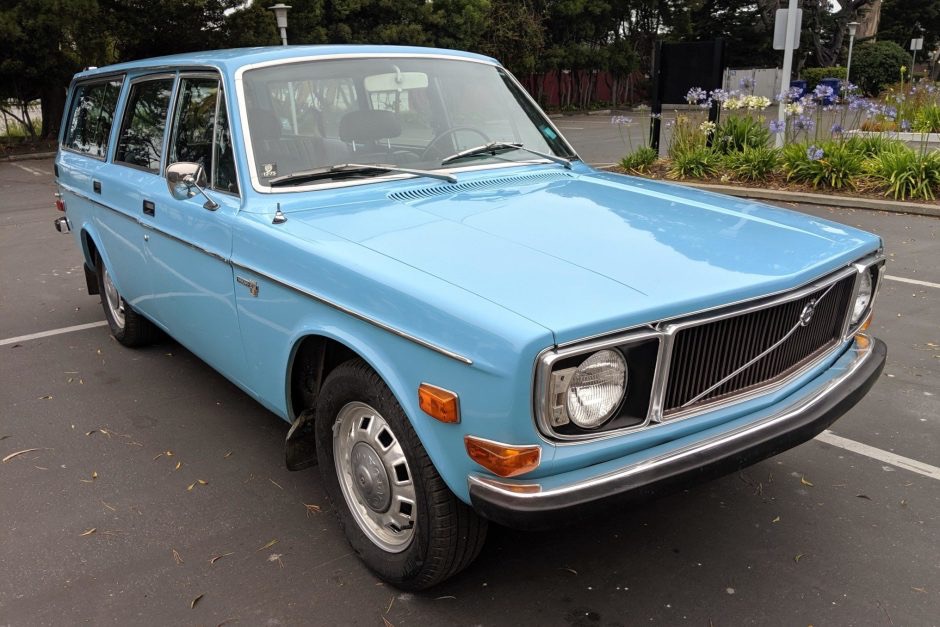
Turns out it is a Volvo. A Volvo? As I’ve owned seven Volvos it is only fitting that my Manager’s Mystery Special is a Volvo. There sat a chunky clunky grey ghost of a car. It didn’t look like my first Volvo, a 1972 station wagon. At all.
We opened the trunk. Wait, it isn’t a trunk. It’s a hatchback. A hatchback? That’s a throwback to the late 70’s. We had hatchbacks then. I thought we got rid of all those designers. I guess what goes around comes around. Into the hatch went the size XL plastic fantastic suitcase I snagged at the local church thrift store. It was seriously discounted, as the donor had locked it and failed to inform anyone of the combination. Yes, I can break into a three-dial suitcase lock. If you see my suitcase, and need to look inside, it’s 460.
And, with the backpacks in the back seat, we endeavored to operate the Polestar. Might as well have been a Battlestar Galactica (another 70s reference), with absolutely NO helpful instructions. Thankfully Hertz had placed the typical key fob in the cup holder. But, instead of an obvious START / STOP switch designation, we saw a round button with the icons for PLAY and PAUSE. What is this, a cassette tape deck?
I pressed PLAY and the dash came to life. No sound was heard. But, we managed to get out of the parking space and to the garage gate attendant. “Do you want to prepay for your electricity? Or do you want to bring it back at this level?” Hmmm. I always detest how Hertz jacks up your rental cost with unnecessary charges. “I’ll recharge it myself.” How hard can that be, I thought.
Thankfully with an unfamiliar car we weren’t in an unfamiliar city. But, coming to the first stop, the EV’s use of the electric motor to apply a braking force was certainly unfamiliar. You don’t brake with a separate pedal. You just let off the “gas pedal.” I did. My wife nearly exited the car through the windshield. I’m lucky she didn’t smack me upside of my head in return for my poor driving. “It’s the car! I just…”. “Don’t do that again!”
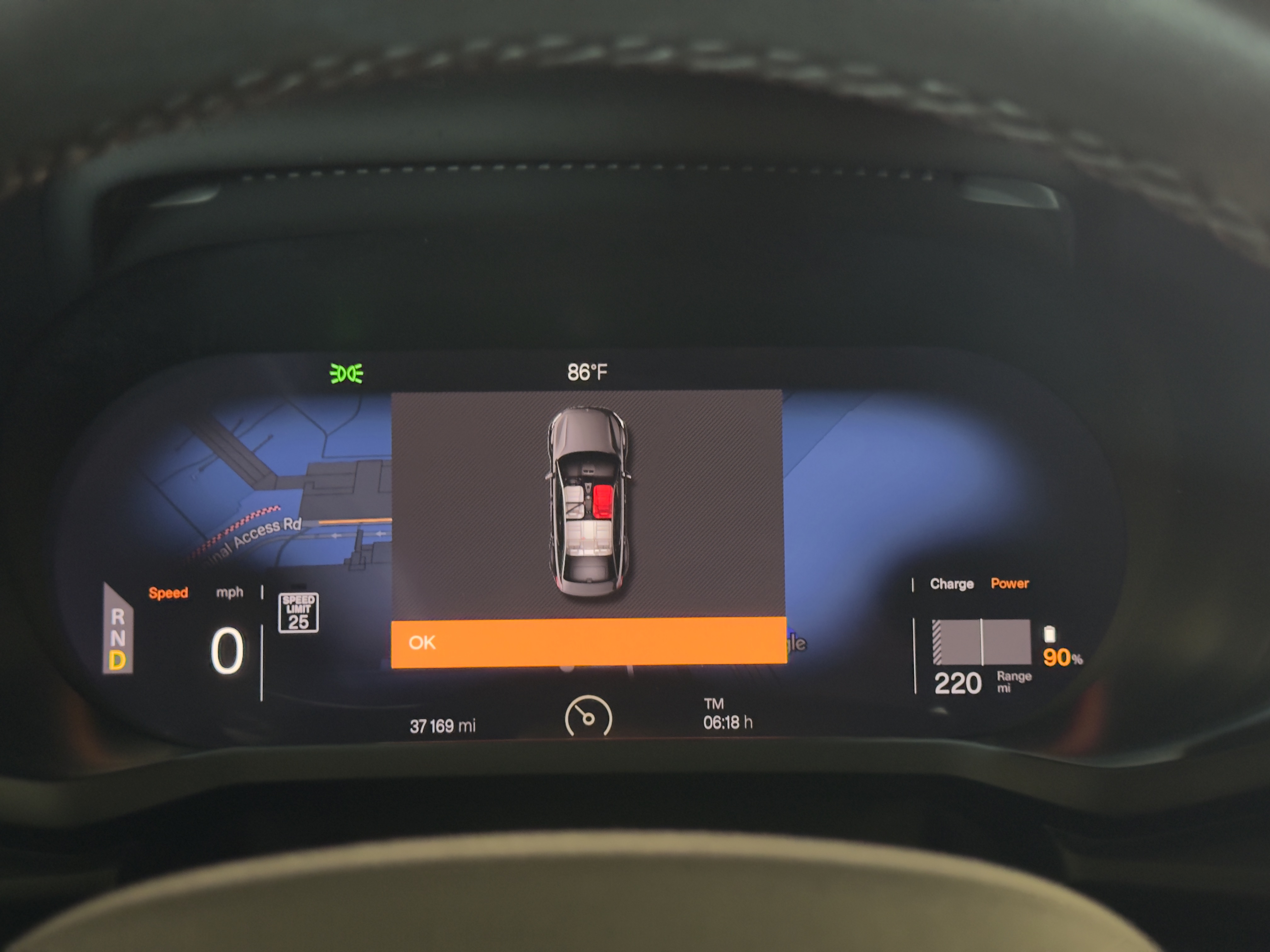
The Apple CarPlay got us to the hotel, where we backed into a shady spot. “How do you stop this thing?” I wondered after moving the motion selector (NO actual gears in this car!) to P. I pressed the PLAY/PAUSE button. Nothing. We fiddled with the touch screen icons. Maybe here? Indeed, on a touch screen you can shut the car off. I noted with some curiosity that my energy gauge had dropped from 91% to 81%. In only fourteen miles? Let’s see, 10% drop in 14 miles…that would be a range of…not enough!
Checking in, we felt somewhat relieved to be in a normal activity. But, back out to the Polestar for a ride to a nearby beer and burger joint to meet everyone for a party. Then to the local hockey game. No issues with the car, and driving it became more familiar. I even managed to find a setting for vehicle braking on the touch screen. Did I want the car to brake like an EV, or like a real car? With a tap, the braking power dropped and my wife was no longer experiencing the brain-rattling fatigue she enjoyed. Until I needed to pass someone and stepped on the gas. Our heads thumped backwards into the headrest with the incredible acceleration of the motor. “Yes dear, I won’t do that again.”
The next few days were interesting. The energy gauge continued to drop. The distance to empty remained reasonable, but the loss of power each mile was notable. I think gasoline-fueled cars have a non-linear fuel gauge response to combat our natural fear of being stranded, with a slow decline until you get to that last quarter tank. The EV has a very precise gauge, so you know exactly what you’re up against. Will I make it there and back?
With the Hertz clerk admonition to return at 90%, I had to learn how to recharge before the last minute. We had no idea how long it would take to recharge, how much money it would cost, etc. So we looked for EV charging stations, and found one near the mall. Perfect. Not really. Tesla had taken over the entire complex, and you needed a Tesla account and app and all that goes with it. Several minutes later, the recharger still had not recognized me as a human being with money, so we moved on with some frustration. I’m sure if we were driving a Tesla it would be trouble-free. But, absent that relationship, it was just a non-starter.
The Tesla Supercharger at Miromar Outlets Mall
Visiting my stepfather at his retirement center, we discovered a few charging stations there. Setting up payment there was much simpler. Much like any purchase, using your iPhone as a credit card. We stopped at the offices for a short discussion, and returned to the charger to make our next appointment. There I quickly realized that the charging cable does not just pull out of the charging port jack. I was stuck. How do you shut off the charger? How do you disconnect the cable? I reached out to the retirement center phone number on the charger. They didn’t know, and transferred me to the charging company. I am pretty sure that I was talking around the world to one of those countries specializing in phone help. His name was Chuck, I think. Right. In a few minutes, with his remote access, the charger was stopped.
Now, how to disconnect the cable? Without any owner’s manual it was back to the touch screen to tap and pray. Which of the many icons would offer either info or instruction? There! The screen had a button to unlock the cable. Finally. With a tap, I was able to remove the cable and hang it back up.
Looking at the replenishment over that 15-minute attempt, I realized that truly recharging was going to take time. More time than I wanted to spend, hooked up to a white box somewhere I didn’t really want to be.
Driving around the uber-flat terrain of Fort Myers, this EV managed to corner with zero body roll. I don’t think it can roll, as it weighs as much as the entire elephant line at the circus. Small pavement depressions, cracks, or potholes were massively felt. Much like in my ¾ ton 6,000 pound pickup truck.
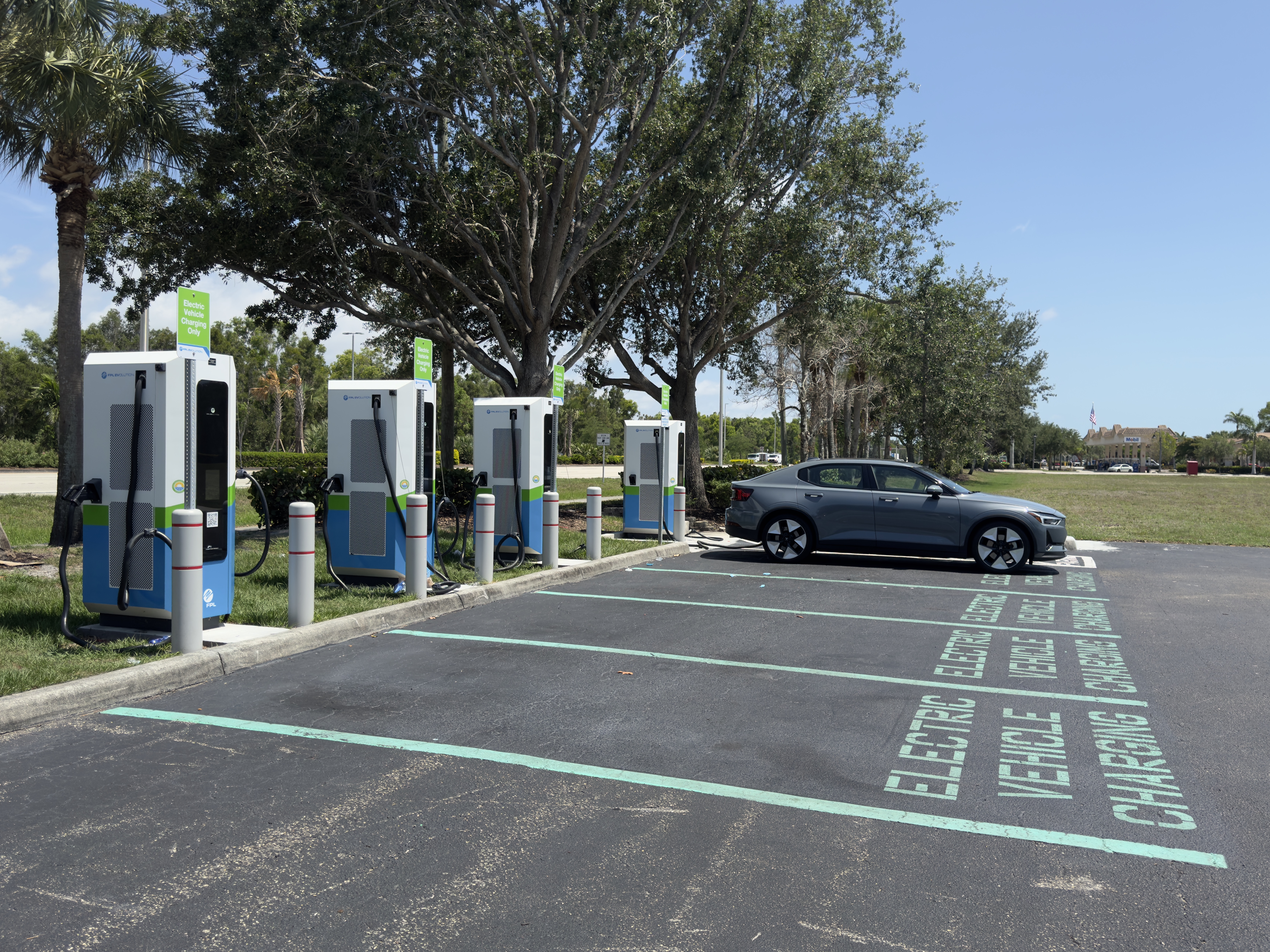
The next day, my “nagivator” had found a Florida Power & Light recharging station near the hotel. It promised fast charging. We were the only EV there, and unlike the Tesla station experience, I could easily create an account, hook up the cable, and send electrons to the batteries. This cable was different than the one at the retirement center. Big, heavy, and a different end. Aha! That’s the high voltage connector…I must remove this plastic cover on the car port. OK. Thanks.
And, so we waited. Being an old married couple, we sat in silence and scrolled our respective social media feeds. For a long time. The Polestar screen said we would be there for about an hour to restore to 94%. No way. An hour? After about 32 minutes, I stopped the charger, disconnected the cable, and headed to the mall for some retail therapy.
The rest of our visit went well, and with the time required to recharge now known, we planned our route back to the airport. Instead of leaving with enough time to fill up a gas tank, maybe five minutes, we had to plan for that 29-minute recharge. Up early, pack, wolf down a simply horrible breakfast of overcooked powdered eggs, paper thin bacon strips, runny oatmeal, and weak coffee, and head to that recharger. More scrolling, a bit more conversation, and in time, the gauge read 96%. Would I be able to make it to the airport consuming only 6% of the battery? I had no choice but to go, to make the flight.
I spent about $18 on electricity in driving 130 miles around town. That’s not very economical. With a modern car averaging 33 mpg, those same miles would cost only $16. In my 3/4 ton pickup truck, 130 miles is $40, so definite savings in that comparison.
Driving in Florida like an old man, I managed to slow traffic on the interstate, and in so doing, induce a few truck drivers’ road rage. But, my careful driving, along with aggressive braking to regenerate some power, we rolled into the RSW garage at 90%. Victory. I think. Mission over.
We realized that the EV experience was not what we expected, nor what we hoped. It was initially exciting for at least one engineer, seeing new technology and gee-whiz features. Much like seeing that new girl at the bar smile at you, as you think “I can do this, I can buy her a drink, I can talk to her…”. But, after you buy that drink and talk for a while, you realize that her pretty face hides very confusing thoughts, and her long legs and high heels won’t make it very far down the road to your apartment. I needed a girl wearing a tank top under a checkered shirt, Wranglers and boots made for walking. Not dancing.
Would I buy an EV? Could I enjoy an EV? I suppose so. Much like any new toy, you have to learn how to use it. And, you must set up the system for your use. Without question, a home charger would be required. Overnight recharging would eliminate daily range anxiety. That expense, though, can be thousands, without manufacturer support. What charging stations are near me? Do I need multiple charging company accounts? The design features, controls, and driving experience of an EV differ from a traditional car, but more importantly, across the EV choices. Do I want the austere touchscreen only Tesla? Do I prefer a more traditional setup? How’s the visibility backing up to the charging station? Can I carry my super large suitcases to the airport? Each EV, be it Tesla, Ford, GM, Subaru, VW, or Polestar would have to be evaluated before making a good choice.
For me, for now, I’m still so happy with a simple traditional vehicle. It has switches, with words on them, or icons that make sense. I can control the acceleration or braking with my own brain, and judicious pressure on one of two pedals. The big red switch lever says “START/STOP.” It’s a station wagon, with room in the back for whatever I need to carry. It’s perfect. Just like my 1972 Volvo station wagon. It’s even blue.
A 1972 Volvo 145 station wagon much like my first VolvoMy new 2023 MINI Cooper S Clubman











 Seeking To Understand