
Some of us can remember Paul Harvey, the renowned radio announcer who came on the air at about 12:05 pm on Saturday, after the top of the hour news. In the next fifteen minutes, he told an amazing story without divulging the name of the principal subject, and in such a way, that those casually hearing the news actually stopped what they were doing to listen.

I can remember every Saturday at the gas station where I worked in 1977-1979 how we turned up that old AM radio, which was covered with greasy fingerprints, while eating lunch and taking a break from oil changes, tire repair, and pumping gas.
 The story always ended with the big reveal of the person who experienced the events. You could never expect the ending. Not in a million years. At the last possible moment, Mr. Harvey would intone…”and now, you know the rest of the story” as he signed off.
If we read the Old Testament, like a book, at times the stories from one chapter don’t make sense at first. In Exodus 32, we read of the tribes of Israel rebelling against God, while Moses was on Mount Sinai, and his brother Aaron the high priest actually creating the idol of a calf for worship.
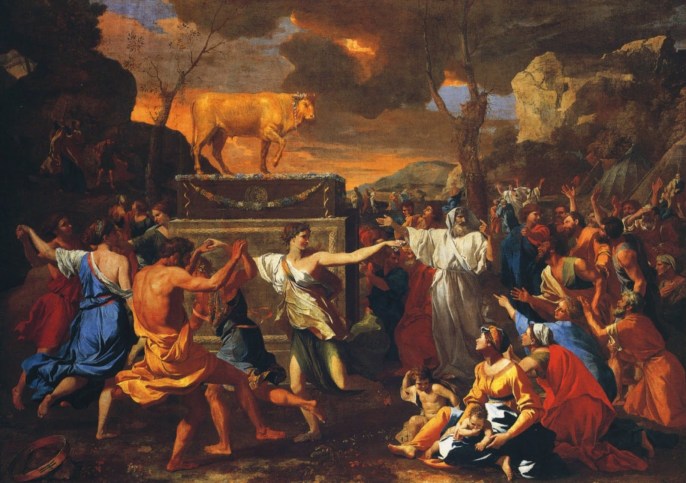 We all naturally wonder how God would ever permit Aaron to take one more breath, with that kind of sin. We struggle to understand God…His apparent forgiveness…for something so bad…and specifically, it seemed, for Aaron.
But, many pages later, we’ve moved into a very interesting passage, one where Moses himself is speaking to the tribes. Imagine, if you will, Moses being on the air on that old AM radio, like Paul Harvey, and all the tribes gathering around to hear him. The stories are retold, but this time, in the first person. “I fell prostrate before the Lord…” and “So I made the ark out of acacia wood…and I went up on the mountain with the two tablets in my hands.” The personal recollections speak powerfully to us.
And, in this passage, we read something of great importance. It is, if you will, the rest of the story. Look at Deuteronomy 9:20
“And the Lord was angry enough with Aaron to destroy him, but at that time I prayed for Aaron too.”
Wow! What seems at first to be most confusing, yes, even concerning, now becomes clear. God in his righteousness wanted to express His valid judgment against Aaron. God in His holiness had every right to destroy Aaron. Moses, in his position as both God’s leader and Aaron’s brother, had a terrible realization that he loved God, and yet he loved his brother too. Can you imagine the conflict he felt inside? We can’t know what Moses prayed, but I imagine it was words recognizing both God’s holiness and judgment, and Aaron’s shortcomings and humanity.
So we see that God remained God, throughout this time. Aaron, a high priest, experienced a restoration through repentance, yet also was punished in accordance with his sin. God in his sovereignty chose, on His own, to forbear Aaron’s sin, to provide absolution, and to use Aaron for many years in leading the nation in worship and adoration. Moses learned time and time again that prayer allowed God to show Himself, His true nature, His power, His holiness, and His faithfulness to His chosen people. Prayer didn’t change God, to be sure. Prayer changed Moses.
Read God’s Word! Trust that God will never change, and that He will reveal Himself to you in your time together. When you find something that doesn’t make sense, allow it to be a time of learning. Pray. Pray like Moses did. And in time, God may give you a chance to share with your tribe the faithfulness of God in your life.
 Seeking To Understand